Solved Campfire-1 from Hack The Box!
| Field | Details |
|---|---|
| Case Reference | HTB-SHRLCK-CAMPFIRE-1 |
| Platform | Hack The Box — Sherlock |
| Category | DFIR — Kerberoasting Attack |
| Difficulty | — |
| Date Opened | 2024-05-21 |
| Severity | High |
| Status | Closed — training scenario |
| Hosts | DC01.forela.local (Domain Controller), affected workstation |
| Attacker IP | 172.17.79.129 |
| Evidence | DC Security logs, PowerShell-Operational logs, Prefetch files |
| Tools | Chainsaw, Hayabusa (Sigma rules), jq, PECmd (Eric Zimmerman) |
Scenario: Alonzo spotted weird files on his computer and informed the newly assembled SOC Team. Assessing the situation, it is believed a Kerberoasting attack may have occurred in the network. It is your job to confirm the findings by analyzing the provided evidence. You are provided with: (1) Security Logs from the Domain Controller, (2) PowerShell-Operational Logs from the affected workstation, (3) Prefetch Files from the affected workstation.
1. Executive Summary
On 2024-05-21 a Kerberoasting attack occurred on DC01.forela.local. The attacker (from workstation 172.17.79.129, user alonzo.spire) first enumerated Active Directory with PowerView.ps1 (loaded at 03:16:32 UTC), then executed Rubeus.exe at 03:18:08 UTC to request an RC4-encrypted (0x17) service ticket for MSSQLService — the Domain Controller logged the malicious Kerberos ticket request (Event ID 4769) exactly one second later at 03:18:09 UTC. The entire chain was reconstructed using Chainsaw (Sigma rules) on DC security logs, PowerShell Script Block Logging (Event ID 4104) on the workstation, and PECmd Prefetch forensics.
1.1 Incident Summary
| Field | Details |
|---|---|
| Incident Type | Kerberoasting attack against a SQL Server service account |
| Initial Access | Domain user alonzo.spire on workstation 172.17.79.129 |
| Discovery | Alonzo spotted weird files; SOC triage |
| First Execution | 2024-05-21 03:16:32 UTC (PowerView loaded) |
| Persistence | None observed |
| Overall Severity | High |
1.2 Key Findings
- Kerberoasting detected at
2024-05-21 03:18:09 UTCvia Event ID 4769 (RC4-HMAC, 0x17). - Targeted service:
MSSQLService(SQL Server service account with SPN). - Attacker workstation IP:
172.17.79.129. - AD enumeration tool:
PowerView.ps1(PowerSploit) loaded at 03:16:32 UTC. - Kerberoasting tool:
Rubeus.exeatC:\Users\Alonzo.spire\Downloads\Rubeus.exe, executed at 03:18:08 UTC (Prefetch). - Rubeus left no Windows Event Log traces — only Prefetch evidence.
2. Investigation Scope & Artifacts
2.1 Artifacts Analyzed
| Artifact | Format | What it answers |
|---|---|---|
SECURITY-DC.evtx |
Windows Security log (DC) | Kerberoasting (EID 4769) — Q1, Q2, Q3 |
campfire.json (PowerShell-Operational) |
JSON (Chainsaw dump) | PowerView execution — Q4, Q5 |
RUBEUS.EXE-5873E24B.pf |
Prefetch file | Rubeus path and execution time — Q6, Q7 |
2.2 Tools & Methods
| Tool | Purpose |
|---|---|
| Chainsaw + Hayabusa (Sigma rules) | Automated Kerberoasting detection on DC security logs |
| jq | Filter campfire.json for Event ID 4104 (Script Block Logging) |
| PECmd (Eric Zimmerman) | Prefetch parsing (Rubeus.exe path, run count, last run time) |
3. Technical Analysis
3.1 Scenario
Kerberoasting attack investigation on a domain controller. The attacker enumerated AD with PowerView, then used Rubeus to request RC4-encrypted service tickets for offline cracking. Evidence spans DC security logs, PowerShell operational logs, and Prefetch files.
3.2 Q1 — Analyzing Domain Controller Security Logs, can you confirm the UTC date & time when the kerberoasting activity occurred?
Answer: 2024-05-21 03:18:09
chainsaw hunt SECURITY-DC.evtx -s ~/tools/hayabusa/rules/sigma -r ~/tools/hayabusa/rules --mapping ~/tools/chainsaw/mappings/sigma-event-logs-all.yml
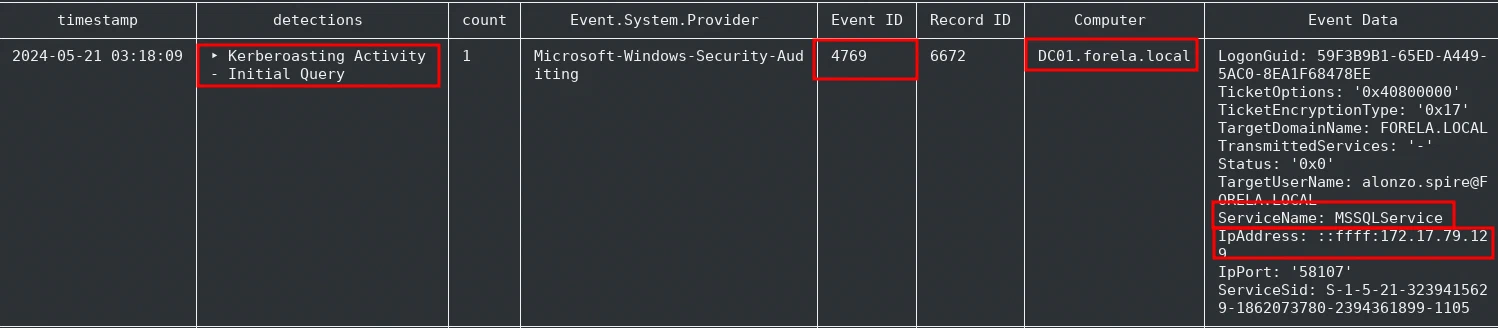
Chainsaw automatically detected Kerberoasting activity by matching Sigma rules against the Domain Controller security logs.
Key fields (Sysmon Event ID 4769 — Kerberos Service Ticket Request):
Timestamp:            2024-05-21 03:18:09 UTC
Computer:             DC01.forela.local
TargetUserName:       alonzo.spire@FORELA.LOC
ServiceName:          MSSQLService
TicketEncryptionType: 0x17 (RC4-HMAC) ← weak encryption, kerberoastable
TicketOptions:        0x40800000
IpAddress:            172.17.79.129
IpPort:               58107
The encryption type 0x17 (RC4-HMAC) is the key indicator of Kerberoasting. An attacker requests a service ticket for MSSQLService using weak RC4 encryption instead of AES — the ticket can then be extracted and cracked offline to reveal the service account password.
Detection angle. EID 4769 with TicketEncryptionType: 0x17 (RC4-HMAC) for an SPN account — Kerberoasting signature.
3.3 Q2 — What is the Service Name that was targeted?
Answer: MSSQLService
Identified directly from the Chainsaw output in Q1. Event ID 4769 field ServiceName: MSSQLService. MSSQLService is a Microsoft SQL Server service account. Service accounts running under domain credentials are prime Kerberoasting targets because they have SPNs (Service Principal Names) registered in Active Directory, allowing any domain user to request a service ticket and attempt offline cracking.
Detection angle. EID 4769 ServiceName field — identifies the targeted SPN account.
3.4 Q3 — It is really important to identify the Workstation from which this activity occurred. What is the IP Address of the workstation?
Answer: 172.17.79.129
Identified directly from the Chainsaw output in Q1. Event ID 4769 field IpAddress: ::ffff:172.17.79.129 — the actual workstation IP is 172.17.79.129. This is the machine from which alonzo.spire ran the Kerberoasting attack.
Detection angle. EID 4769 IpAddress field — source workstation IP.
3.5 Q4 — Now that we have identified the workstation, a triage including PowerShell logs and Prefetch files are provided. What is the name of the file used to Enumerate Active Directory objects and possibly find Kerberoastable accounts?
Answer: PowerView.ps1
cat campfire.json | jq 'select(.EventID == 4104) | "\(.Timestamp)--> \(.ExtraFieldInfo.Path)"' | sort | uniq -c
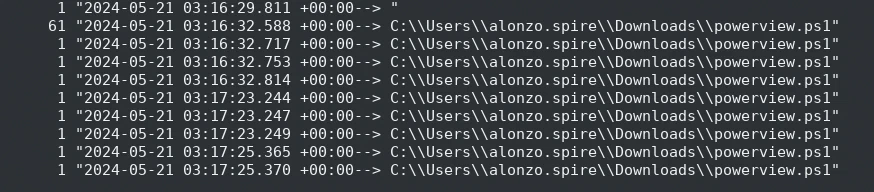
Event ID 4104 — PowerShell Script Block Logging captures all executed PowerShell scripts including their full path. Filtered campfire.json for ID 4104 and extracted the script path. Results show powerview.ps1 executed by alonzo.spire from: C:\Users\alonzo.spire\Downloads\powerview.ps1.
Execution pattern:
2024-05-21 03:16:32— 61 blocks logged simultaneously (script loaded — all functions)2024-05-21 03:17:23— 5 blocks logged (specific functions called)2024-05-21 03:17:25— 2 blocks logged (additional queries)
PowerView is a PowerShell tool from the PowerSploit framework used for Active Directory enumeration. It can identify Kerberoastable accounts by querying for service accounts with SPNs registered — exactly what was used here to find MSSQLService before the Kerberoasting at 03:18:09.
Detection angle. EID 4104 ScriptBlockText containing PowerView or Get-DomainUser -SPN — AD enumeration for Kerberoasting targets.
3.6 Q5 — When was this script executed? (UTC)
Answer: 2024-05-21 03:16:32
Identified from the same ID 4104 query used in Q4. The first execution of powerview.ps1 was logged at 2024-05-21 03:16:32.588 UTC. The 61 script blocks logged at this exact timestamp indicate the entire PowerView script was loaded into memory at once — all functions and modules initialised simultaneously. Subsequent executions at 03:17:23 and 03:17:25 represent individual PowerView functions being called after the initial load.
Detection angle. EID 4104 first timestamp with 61 simultaneous script blocks — PowerView full-script load.
3.7 Q6 — What is the full path of the tool used to perform the actual kerberoasting attack?
Answer: C:\Users\Alonzo.spire\Downloads\Rubeus.exe
.\PECmd.exe -f C:\Users\user\Documents\htb\Campfire\prefetch\RUBEUS.EXE-5873E24B.pf
Files referenced: 109
00: \VOLUME{01d951602330db46-52233816}\WINDOWS\SYSTEM32\NTDLL.DLL
01: \VOLUME{01d951602330db46-52233816}\USERS\ALONZO.SPIRE\DOWNLOADS\RUBEUS.EXE (Executable: True)
No evidence of Rubeus execution was found in Windows Event Logs — Rubeus runs entirely in memory and avoids leaving obvious log traces. The prefetch file RUBEUS.EXE-5873E24B.pf was identified in the provided prefetch folder. Prefetch files are created by Windows every time an executable runs, making them reliable evidence of execution even when logs are absent. Parsed with PECmd (Eric Zimmerman) on FlareVM:
Executable:  RUBEUS.EXE
Full path:   C:\Users\Alonzo.spire\Downloads\Rubeus.exe
Run count:   1
Last run:    2024-05-21 03:18:08 UTC
Rubeus is an open-source Kerberos attack toolkit. It can perform Kerberoasting by requesting RC4-encrypted service tickets for accounts with SPNs and dumping them for offline cracking — exactly matching the ID 4769 event observed in Q1.
Detection angle. Prefetch file RUBEUS.EXE-*.pf — Rubeus execution evidence when Windows Event Logs are absent.
3.8 Q7 — When was the tool executed to dump credentials? (UTC)
Answer: 2024-05-21 03:18:08
Processing C:\Users\user\Documents\htb\Campfire\prefetch\RUBEUS.EXE-5873E24B.pf

Created on: 2026-03-24 09:15:27
Modified on: 2024-05-21 03:18:09
Last accessed on: 2026-03-24 09:18:28

Executable name: RUBEUS.EXE
Hash: 5873E24B
File size (bytes): 86,612
Version: Windows 10 or Windows 11

Run count: 1
Last run: 2024-05-21 03:18:08
Prefetch file timestamps explained:
- Created on:
2026-03-24— when the.pffile was copied to the analysis machine - Modified on:
2024-05-21 03:18:09— when prefetch was last updated on the victim - Last accessed:
2026-03-24— when we opened it for analysis - Last run:
2024-05-21 03:18:08— ACTUAL execution time on victim ← answer
The “Last run” field is the reliable timestamp — it records when Rubeus.exe last executed on the victim machine. This confirms the attack sequence with 1-second precision:
03:18:08— Rubeus.exe executed (this question)03:18:09— ID 4769 logged on DC01 (Kerberoasting detected in Q1)
Rubeus ran at 03:18:08 and the domain controller logged the malicious ticket request exactly 1 second later at 03:18:09.
Detection angle. PECmd “Last run” field (not “Created on”/“Modified on”) — actual execution timestamp on the victim.
4. Challenge Q&A Log
| # | Question | Answer | Method |
|---|---|---|---|
| 1 | Kerberoasting timestamp (UTC) | 2024-05-21 03:18:09 |
Chainsaw Sigma (EID 4769) |
| 2 | Targeted service name | MSSQLService |
EID 4769 ServiceName |
| 3 | Attacker workstation IP | 172.17.79.129 |
EID 4769 IpAddress |
| 4 | AD enumeration tool | PowerView.ps1 |
EID 4104 (PowerShell) |
| 5 | PowerView execution time (UTC) | 2024-05-21 03:16:32 |
EID 4104 first timestamp |
| 6 | Kerberoasting tool full path | C:\Users\Alonzo.spire\Downloads\Rubeus.exe |
Prefetch (PECmd) |
| 7 | Rubeus execution time (UTC) | 2024-05-21 03:18:08 |
Prefetch “Last run” |
5. Incident Narrative
On 2024-05-21 the attacker (user alonzo.spire on workstation 172.17.79.129) first enumerated Active Directory with PowerView.ps1 (loaded at 03:16:32 UTC), identifying MSSQLService as a Kerberoastable account. At 03:18:08 UTC the attacker executed Rubeus.exe from C:\Users\Alonzo.spire\Downloads\ to request an RC4-encrypted (0x17) service ticket for MSSQLService. The Domain Controller (DC01.forela.local) logged the malicious Kerberos ticket request (Event ID 4769) exactly one second later at 03:18:09 UTC. Rubeus left no Windows Event Log traces — only Prefetch evidence. The entire chain was reconstructed using Chainsaw (Sigma rules) on DC security logs, PowerShell Script Block Logging (Event ID 4104) on the workstation, and PECmd Prefetch forensics.
6. Attack Timeline
| Timestamp (UTC) | Event | Artifact | ATT&CK |
|---|---|---|---|
| 2024-05-21 03:16:32 | PowerView.ps1 loaded (61 script blocks) — AD enumeration | EID 4104 | T1087.002 |
| 2024-05-21 03:17:23 | PowerView functions called (5 blocks) | EID 4104 | T1087.002 |
| 2024-05-21 03:17:25 | Additional PowerView queries (2 blocks) | EID 4104 | T1087.002 |
| 2024-05-21 03:18:08 | Rubeus.exe executed (Prefetch “Last run”) | Prefetch | T1558.003 |
| 2024-05-21 03:18:09 | Kerberoasting detected — EID 4769, RC4 (0x17), ServiceName MSSQLService |
DC Security log | T1558.003 |
7. Indicators of Compromise (IOCs)
7.1 File IOCs
| Type | Value | Context |
|---|---|---|
| File Name | PowerView.ps1 |
AD enumeration tool — Q4 |
| File Path | C:\Users\alonzo.spire\Downloads\PowerView.ps1 |
PowerView location — Q4 |
| File Name | Rubeus.exe |
Kerberoasting tool — Q6 |
| File Path | C:\Users\Alonzo.spire\Downloads\Rubeus.exe |
Rubeus location — Q6 |
| Prefetch | RUBEUS.EXE-5873E24B.pf |
Rubeus execution evidence — Q6/Q7 |
7.2 Network IOCs
| Type | Value | Context |
|---|---|---|
| IP Address | 172.17.79.129 |
Attacker workstation — Q3 |
| Domain | FORELA.LOC |
Target domain |
7.3 Behavioral IOCs
| Type | Value | Context |
|---|---|---|
| Account | alonzo.spire@FORELA.LOC |
Attacker’s domain account |
| Service | MSSQLService |
Targeted SPN account — Q2 |
| Encryption | 0x17 (RC4-HMAC) |
Weak encryption — Kerberoasting indicator — Q1 |
| Ticket Options | 0x40800000 |
Kerberoasting indicator — Q1 |
| Tool | Rubeus | Kerberos attack toolkit — Q6/Q7 |
| Tool | PowerView (PowerSploit) | AD enumeration — Q4 |
8. Detection Opportunities
| Source | What to look for | Why it matters |
|---|---|---|
| Domain Controller Security (EID 4769) | Kerberos ticket request with TicketEncryptionType: 0x17 (RC4) for an SPN account |
Kerberoasting signature — Q1 |
| Domain Controller Security (EID 4769) | ServiceName field — identifies targeted SPN account |
Target identification — Q2 |
| PowerShell (EID 4104) | ScriptBlockText containing PowerView or Get-DomainUser -SPN |
AD enumeration for Kerberoasting — Q4 |
| Prefetch | RUBEUS.EXE-*.pf in the prefetch folder |
Rubeus execution even when event logs are absent — Q6/Q7 |
| Chainsaw/Hayabusa (Sigma) | Automated Kerberoasting detection on DC security logs | Signature-based detection — Q1 |
9. MITRE ATT&CK Mapping
| TTP ID | Tactic | Technique | Evidence |
|---|---|---|---|
| T1558.003 | Credential Access | Steal or Forge Kerberos Tickets: Kerberoasting | RC4 (0x17) ticket for MSSQLService — Q1 |
| T1087.002 | Discovery | Account Discovery: Domain Account | Get-DomainUser -SPN via PowerView — Q4 |
10. Conclusions & Recommendations
10.1 Incident Summary
| What Happened | An attacker (alonzo.spire) enumerated AD with PowerView, then used Rubeus to Kerberoast the MSSQLService account, requesting an RC4-encrypted service ticket for offline cracking. |
|---|---|
| Root Cause | Service account (MSSQLService) had an SPN registered and used RC4 encryption (weak, crackable). No monitoring for RC4 ticket requests. |
| Impact Assessment | Confidentiality: High — service account password potentially compromised (offline cracking). Integrity: Medium — potential for lateral movement with cracked creds. Availability: Low — no service disruption. |
10.2 Recommendations
| Priority | Timeframe | Recommendation |
|---|---|---|
| Immediate | Within 24h | Reset MSSQLService password; disable RC4 (enforce AES) for Kerberos; check for additional Kerberoasting |
| High | Within 7 days | Alert on EID 4769 with TicketEncryptionType: 0x17 for SPN accounts; monitor PowerView/Rubeus usage |
| Medium | Within 30 days | Use gMSA (Group Managed Service Accounts) for service accounts; enable PowerShell Script Block Logging |
| Low | Within 90 days | User awareness for credential hygiene; review SPN registrations |
| Strategic | Ongoing | Baseline EID 4769 events; deploy Sigma rules via Chainsaw/Hayabusa for Kerberoasting |
11. Analyst Notes & Learning
11.1 What I Did Well
Correlated three evidence sources (DC security logs, PowerShell operational logs, Prefetch files) to reconstruct the attack with 1-second precision. Used Chainsaw with Sigma rules for automated Kerberoasting detection. Distinguished “Last run” from “Created on”/“Modified on” in Prefetch timestamps.
11.2 Key Takeaways
- Kerberoasting requires only a domain user account — no elevated privileges needed.
- RC4 (0x17) encryption is the tell — legitimate tickets use AES (0x12/0x11).
- PowerView + Rubeus is the standard Kerberoasting toolchain.
- Rubeus runs in memory — no Windows Event Log traces; Prefetch is the forensic fallback.
- Prefetch “Last run” is the reliable execution timestamp, not “Created on”/“Modified on”.
- Event ID 4769 on the DC is the primary detection point for Kerberoasting.
11.3 New Techniques
Chainsaw + Sigma rule hunting on DC security logs, PowerShell Script Block Logging (EID 4104) analysis, PECmd Prefetch parsing, Kerberoasting detection via RC4 encryption type (0x17), and Rubeus/PowerView toolchain identification.
12. References
- Campfire-1 — Hack The Box Sherlock
- MITRE ATT&CK — T1558.003 Kerberoasting
- MITRE ATT&CK — T1087.002 Account Discovery
- PECmd — Prefetch parser
- chainsaw
- hayabusa
- Rubeus
- PowerSploit / PowerView
HTB Sherlock · Campfire-1 · Kerberoasting · 2024-05-21