Solved CrashDump from Hack The Box!
| Field | Details |
|---|---|
| Case Reference | HTB-SHRLCK-CRASHDUMP |
| Platform | Hack The Box — Sherlock |
| Category | Memory Forensics — Cobalt Strike Beacon (User-Mode Dump) |
| Difficulty | Easy |
| Date Opened | 2026-03-27 |
| Severity | High |
| Status | Closed — training scenario |
| Dumps | notepad.DMP, update.DMP |
| Tools | WinDbg, minidump (skelsec), strings, xxd, Python |
Scenario: A suspicious executable was identified running on one of the compromised endpoints. Initial triage suggests that this process may have been leveraged by the threat actor to establish a foothold on the system. To support further malware analysis and behavioral reconstruction, a user-mode process dump of the suspected executable has been provided.
1. Executive Summary
A user-mode process dump (update.DMP) of a malicious executable (update.exe, running from C:\Users\s1rx\Downloads\) was analyzed with WinDbg and minidump. The process injected shellcode into notepad.exe (PID 2336) at base address 0xb120870000 (Cobalt Strike x64 shellcode prologue fc 48 83 e4 f0). The process used 6 threads and communicated over the named pipe MSSE-1641-server (Cobalt Strike SMB Beacon). The C2 server IP is 101.10.25.4. The OS build is 10.0.10240.16384 (Windows 10). The injected shellcode’s last thread was created at 2025-11-05 01:09:12 UTC.
1.1 Incident Summary
| Field | Details |
|---|---|
| Incident Type | Cobalt Strike beacon — process injection into notepad.exe |
| Initial Access | Suspicious executable update.exe in C:\Users\s1rx\Downloads\ |
| Discovery | User-mode process dump triage |
| Malicious Process | update.exe (path C:\Users\s1rx\Downloads\update.exe) |
| Injected Process | notepad.exe (PID 2336) |
| Overall Severity | High |
1.2 Key Findings
- OS version:
10.0.10240.16384(Windows 10). - Malicious executable path:
C:\Users\s1rx\Downloads\update.exe. - Thread count: 6 (suspicious for a simple updater).
- Named pipe:
MSSE-1641-server(Cobalt Strike SMB Beacon IPC channel). - Injected process PID:
2336(notepad.exe). - Last thread creation:
2025-11-05 01:09:12 UTC. - Shellcode base address:
0xb120870000(Cobalt Strike x64 prologuefc 48 83 e4 f0). - C2 server IP:
101.10.25.4. - C2 framework: Cobalt Strike.
2. Investigation Scope & Artifacts
2.1 Artifacts Analyzed
| Artifact | Format | What it answers |
|---|---|---|
notepad.DMP |
User-mode minidump (injected process) | Q1, Q4, Q5, Q6, Q7 |
update.DMP |
User-mode minidump (malicious process) | Q2, Q3, Q4, Q8 |
2.2 Tools & Methods
| Tool | Purpose |
|---|---|
| WinDbg | !analyze -v for OS version and system state |
| minidump (skelsec) | PEB, threads, memory regions, misc info extraction |
strings (ASCII + Unicode) |
Named pipe and C2 IP extraction |
xxd |
Hex dump of shellcode bytes |
| Python | FILETIME conversion (thread creation timestamp) |
3. Technical Analysis
3.1 Scenario
Analysis of a user-mode process dump of a suspected malicious executable (update.exe). The process was leveraged by the threat actor to establish a foothold. The dumps (notepad.DMP, update.DMP) support malware analysis and behavioral reconstruction.
3.2 Q1 — Provide the operating system version.
Answer: 10.0.10240.16384
Opened notepad.DMP in WinDbg and ran !analyze -v. WinDbg is a Windows debugger developed by Microsoft that analyzes memory dumps, crash dumps, and minidumps, providing details about system state, loaded modules, thread stacks, exception records, and OS version.
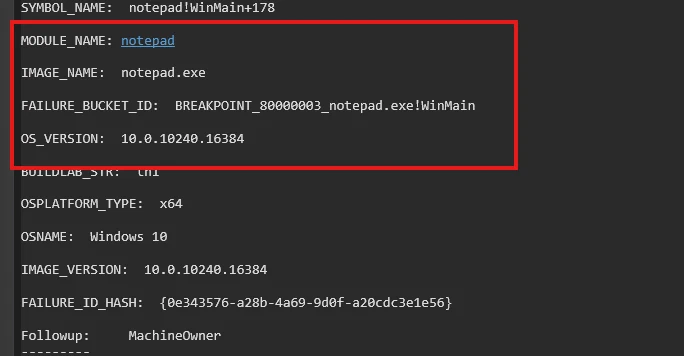
Detection angle. WinDbg !analyze -v on a minidump — OS version (10.0.10240.16384) confirms Windows 10 build.
3.3 Q2 — Provide the full path of the malicious executable used to gain initial access.
Answer: C:\Users\s1rx\Downloads\update.exe
Used minidump (Python) on both notepad.DMP and update.DMP, reading the PEB (Process Environment Block) info to find the full path. The answer is in update_all.txt — the ImagePath field reveals the full path.
# The commands used
$ minidump notepad.DMP --all > notepad_all.txt
$ minidump update.DMP --all > update_all.txt

$ cut update_all.txt
PEB ADDR: 0x7ff5ffff6000
BeingDebugged: 0
ImageBaseAddress: 0x400000
ProcessParameters: None
ImagePath: C:\Users\s1rx\Downloads\update.exe
CommandLine: "C:\Users\s1rx\Downloads\update.exe"
WindowTitle: C:\Users\s1rx\Downloads\update.exe
CurrentDirectory: C:\Users\s1rx\Downloads\
Detection angle. minidump --all PEB ImagePath field — reveals the true executable path even if the process name is masqueraded.
3.4 Q3 — How many threads did the malicious process use?
Answer: 6
Using minidump update.DMP --threads found 6 threads running under the malicious process. Multiple threads in a process like update.exe is suspicious — Cobalt Strike uses additional threads for tasks like beacon callbacks, pipe communication, and post-exploitation jobs.
$ minidump update.DMP --threads
# minidump 0.0.24

ThreadList
ThreadId | SuspendCount | PriorityClass | Priority | Teb
-------------------------------------------------------------------
0xbdc    | 0            | 32            | 0        | 0x7ff5ffffd000
0x3ec    | 0            | 32            | 0        | 0x7ff5ffff9000
0xa14    | 0            | 32            | 0        | 0x7ff5ffff7000
0xe30    | 0            | 32            | 0        | 0x7ff5ffff4000
0x448    | 0            | 32            | 0        | 0x7ff5ffffb000
0x8      | 0            | 32            | 0        | 0x7ff5ffece000
Detection angle. minidump --threads thread count — abnormally high thread count for a simple updater.
3.5 Q4 — Provide the named pipe (IPC channel) used by the malicious process.
Answer: MSSE-1641-server
First, extracted all strings from both dump files in ASCII and Unicode format (Windows stores some strings in ASCII and others in UTF-16LE, so both passes are necessary):
$ strings -a notepad.DMP > notepad_ascii_strings.txt
$ strings -a -el notepad.DMP > notepad_unicode_strings.txt
$ strings -a update.DMP > update_ascii_strings.txt
$ strings -a -el update.DMP > update_unicode_strings.txt
Then searched all extracted strings for named pipe references:
$ grep -i '\\pipe\\' *_strings.txt | sort -u
Results:
| File | Pipe | Type |
|---|---|---|
update_ascii_strings.txt |
\\.\pipe\MSSE-1641-server |
Cobalt Strike SMB Beacon |
update_unicode_strings.txt |
\\.\pipe\postex_3d6e |
Cobalt Strike post-exploitation pipe |
notepad_unicode_strings.txt |
\??\pipe\postex_2326 |
Cobalt Strike post-exploitation pipe |
| Various | \pipe\epmapper, \pipe\svcctl, \PIPE\winreg |
Normal Windows services |
The MSSE-1641-server pipe stands out as the primary IPC channel. The name mimics “Microsoft Security Essentials” (MSSE) to appear legitimate, but it is the default Cobalt Strike SMB Beacon named pipe used for peer-to-peer communication between compromised hosts over SMB.
Detection angle. strings + grep '\\pipe\\' on minidumps — named pipe IOCs (Cobalt Strike SMB Beacon pipes).
3.6 Q5 — Provide the PID of the injected process.
Answer: 2336
notepad.exe is the injected process, targeted by update.exe for shellcode injection. To extract its PID we read the MiscInfoStream from the minidump:
$ minidump notepad.DMP --misc
== MinidumpMiscInfo ==
ProcessId 2336
ProcessCreateTime 1762304686
...
Detection angle. minidump --misc → ProcessId field — injected process PID.
3.7 Q6 — At what time was the last thread created for the injected process? (UTC)
Answer: 2025-11-05 01:09:12
To list all threads and their creation timestamps:
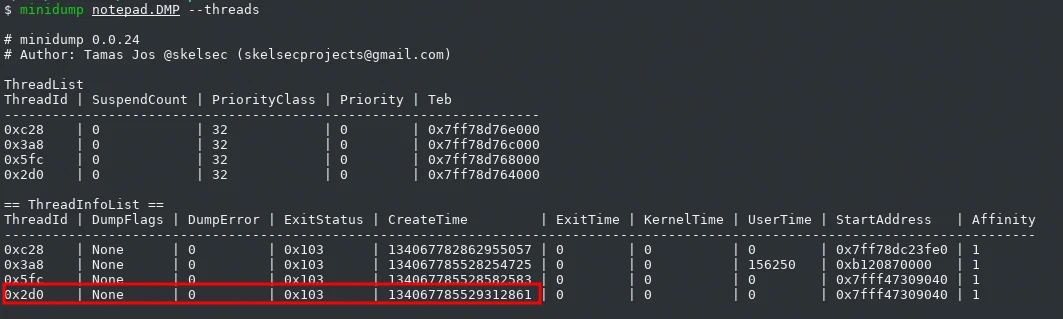
The thread list includes creation times as Windows FILETIME values — 64-bit integers counting 100-nanosecond intervals since January 1, 1601 UTC. Taking the latest timestamp and converting:
python3 -c "import datetime; ft = 134067785529312861; epoch = datetime.datetime(1601,1,1); delta = datetime.timedelta(microseconds=ft//10); print(epoch + delta)"
# 2025-11-05 01:09:12.931286
Detection angle. minidump --threads FILETIME conversion — last thread creation timestamp.
3.8 Q7 — Provide the BaseAddress of the injected shellcode.
Answer: 0xb120870000
To find the shellcode we scan notepad.DMP memory regions for the PAGE_EXECUTE_READWRITE + MEM_PRIVATE combination — the classic IOC for injected code:
PAGE_EXECUTE_READWRITE— memory that is readable, writable, and executable simultaneously. Legitimate code is normally either writable (during load) OR executable (during run), never both.MEM_PRIVATE— not backed by any file on disk. Legitimate DLLs appear asMEM_IMAGE. Private executable memory with no backing file is anomalous.
$ minidump notepad.DMP --memory | grep PAGE_EXECUTE_READWRITE
BaseAddress    | AllocationBase | AllocationProtect | RegionSize | State       | Protect                | Type
0xb120870000   | 0xb120870000   | 64                | 0x1000     | MEM_COMMIT  | PAGE_EXECUTE_READWRITE | MEM_PRIVATE
0xb1221a0000   | 0xb1221a0000   | 64                | 0x4e000    | MEM_COMMIT  | PAGE_EXECUTE_READWRITE | MEM_PRIVATE
0xb123bd0000   | 0xb123bd0000   | 64                | 0x400000   | MEM_COMMIT  | PAGE_EXECUTE_READWRITE | MEM_PRIVATE
This returns three candidate regions. We dump the first bytes of each to identify which contains shellcode vs an injected PE. The region at 0xb120870000 starts with fc 48 83 e4 f0 — the well-known Cobalt Strike x64 shellcode prologue:
FC→CLD(clear direction flag)48 83 E4 F0→AND RSP, 0xFFFFFFFFFFFFFFF0(16-byte stack alignment)
$ minidump -r 0xb120870000 notepad.DMP 2>/dev/null | xxd | head -10
00000000: 0a23 206d 696e 6964 756d 7020 302e 302e  .# minidump 0.0.
00000010: 3234 0a23 2041 7574 686f 723a 2054 616d  24.# Author: Tam
...
00000060: 2066 6320 3438 2038 3320 6534 2066 3020   fc 48 83 e4 f0
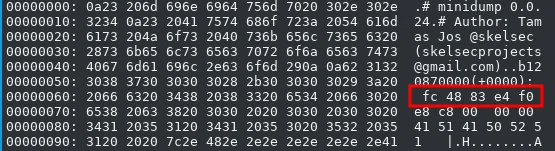
Detection angle. minidump --memory filtered on PAGE_EXECUTE_READWRITE + MEM_PRIVATE — injected shellcode region; prologue fc 48 83 e4 f0 identifies Cobalt Strike.
3.9 Q8 — Provide the C2 server IP address.
Answer: 101.10.25.4
To extract network artifacts from the malicious process dump we run strings and filter for IPs and URLs:
strings -a update.DMP | grep -iE "https?://|ftp://|\b\d{1,3}\.\d{1,3}\.\d{1,3}\.\d{1,3}\b" | less -S
This extracts all printable strings and filters for IP address patterns and common protocol prefixes, revealing the hardcoded C2 address embedded in the update.exe payload.

Detection angle. strings + regex for IP addresses on a process dump — hardcoded C2 IP.
3.10 Q9 — Provide the name of the C2 framework used by the threat actor.
Answer: Cobalt Strike
This was already identified during the shellcode analysis in Q7. The region at 0xb120870000 opens with the byte sequence fc 48 83 e4 f0, which is the well-known x64 Cobalt Strike stager prologue:
FC→CLD(clear direction flag)48 83 E4 F0→AND RSP, 0xFFFFFFFFFFFFFFF0(16-byte stack alignment)
This is one of the most recognizable signatures in memory forensics and is characteristic of Cobalt Strike’s default shellcode template.
Detection angle. Shellcode prologue fc 48 83 e4 f0 — Cobalt Strike x64 stager signature.
4. Challenge Q&A Log
| # | Question | Answer | Method |
|---|---|---|---|
| 1 | Operating system version | 10.0.10240.16384 |
WinDbg !analyze -v |
| 2 | Full path of malicious executable | C:\Users\s1rx\Downloads\update.exe |
minidump --all PEB ImagePath |
| 3 | Threads used by malicious process | 6 |
minidump --threads |
| 4 | Named pipe (IPC channel) | MSSE-1641-server |
strings + grep '\\pipe\\' |
| 5 | PID of injected process | 2336 |
minidump --misc ProcessId |
| 6 | Last thread creation time (UTC) | 2025-11-05 01:09:12 |
minidump --threads FILETIME conversion |
| 7 | BaseAddress of injected shellcode | 0xb120870000 |
minidump --memory PAGE_EXECUTE_READWRITE + MEM_PRIVATE |
| 8 | C2 server IP address | 101.10.25.4 |
strings + IP regex on update.DMP |
| 9 | C2 framework name | Cobalt Strike |
Shellcode prologue fc 48 83 e4 f0 |
5. Incident Narrative
A suspicious executable (update.exe) was identified running on a compromised endpoint. Initial triage suggested the process was leveraged by the threat actor to establish a foothold. A user-mode process dump of the suspected executable (update.DMP) and of the injected process (notepad.DMP) was provided for analysis. The attacker injected Cobalt Strike shellcode (prologue fc 48 83 e4 f0) into notepad.exe (PID 2336) at base address 0xb120870000, using the named pipe MSSE-1641-server (Cobalt Strike SMB Beacon) for IPC. The process used 6 threads and communicated with C2 server 101.10.25.4. The shellcode’s last thread was created at 2025-11-05 01:09:12 UTC. The OS is Windows 10 build 10.0.10240.16384.
6. Attack Timeline
| Timestamp (UTC) | Event | Artifact | ATT&CK |
|---|---|---|---|
| (dump capture) | notepad.DMP and update.DMP captured |
Minidump files | — |
| 2025-11-05 01:09:12 | Last thread created for injected process (notepad.exe, PID 2336) |
minidump --threads |
T1055 |
| (runtime) | Shellcode injected at 0xb120870000 (Cobalt Strike x64 prologue) |
minidump --memory |
T1055.001 |
| (runtime) | Named pipe MSSE-1641-server used for IPC |
strings |
T1071.001? (named pipe) |
| (runtime) | C2 communication to 101.10.25.4 |
strings on update.DMP |
T1071 |
7. Indicators of Compromise (IOCs)
7.1 File IOCs
| Type | Value | Context |
|---|---|---|
| File Name | update.exe |
Malicious executable (Cobalt Strike loader) — Q2 |
| File Path | C:\Users\s1rx\Downloads\update.exe |
Drop location — Q2 |
| File Name | notepad.DMP |
Dump of injected process (PID 2336) |
| File Name | update.DMP |
Dump of malicious process |
7.2 Network IOCs
| Type | Value | Context |
|---|---|---|
| IP Address | 101.10.25.4 |
C2 server — Q8 |
7.3 Behavioral IOCs
| Type | Value | Context |
|---|---|---|
| Named Pipe | MSSE-1641-server |
Cobalt Strike SMB Beacon IPC — Q4 |
| Named Pipe | postex_3d6e / postex_2326 |
Cobalt Strike post-exploitation pipes — Q4 |
| Shellcode | fc 48 83 e4 f0 prologue at 0xb120870000 |
Cobalt Strike x64 stager — Q7/Q9 |
| Memory Region | PAGE_EXECUTE_READWRITE + MEM_PRIVATE |
Injected shellcode IOC — Q7 |
| Process | notepad.exe (PID 2336) injected by update.exe |
Process injection — Q5 |
| Thread Count | 6 threads | Suspicious for a simple updater — Q3 |
8. Detection Opportunities
| Source | What to look for | Why it matters |
|---|---|---|
| Memory forensics | PAGE_EXECUTE_READWRITE + MEM_PRIVATE memory regions |
Injected shellcode IOC — Q7 |
| Memory forensics | Shellcode prologue fc 48 83 e4 f0 |
Cobalt Strike x64 stager signature — Q7/Q9 |
| Memory forensics | Named pipes MSSE-*-server, postex_* |
Cobalt Strike SMB Beacon IPC — Q4 |
| Memory forensics | strings grep for IP addresses on process dumps |
Hardcoded C2 IP — Q8 |
| Process analysis | Abnormally high thread count for a simple executable | Cobalt Strike beacon indicator — Q3 |
| PEB analysis | ImagePath in minidump revealing the true executable path |
Masquerading detection — Q2 |
9. MITRE ATT&CK Mapping
| TTP ID | Tactic | Technique | Evidence |
|---|---|---|---|
| T1055 | Defense Evasion | Process Injection | Shellcode injected into notepad.exe at 0xb120870000 — Q7 |
| T1055.001 | Defense Evasion | Process Injection: Dynamic-link Library Injection | Cobalt Strike shellcode injection — Q7/Q9 |
| T1071 | Command and Control | Application Layer Protocol | C2 to 101.10.25.4 — Q8 |
| T1071.001? | Command and Control | Application Layer Protocol: Web Protocols | Named pipe IPC (SMB) — Q4 |
10. Conclusions & Recommendations
10.1 Incident Summary
| What Happened | A malicious executable (update.exe) injected Cobalt Strike shellcode into notepad.exe (PID 2336), using the named pipe MSSE-1641-server for IPC and communicating with C2 server 101.10.25.4. |
|---|---|
| Root Cause | Suspicious executable (update.exe) in C:\Users\s1rx\Downloads\ was executed, establishing a Cobalt Strike beacon with process injection. |
| Impact Assessment | Confidentiality: High — C2 channel established, shellcode injected. Integrity: High — process injection into notepad.exe. Availability: Low — no destructive action observed. |
10.2 Recommendations
| Priority | Timeframe | Recommendation |
|---|---|---|
| Immediate | Within 24h | Isolate the host; block 101.10.25.4 at the firewall; hunt MSSE-1641-server pipe and update.exe across the estate |
| High | Within 7 days | Terminate update.exe and notepad.exe (PID 2336); collect full memory dump for deeper analysis |
| Medium | Within 30 days | Alert on PAGE_EXECUTE_READWRITE + MEM_PRIVATE memory regions; alert on Cobalt Strike shellcode prologue fc 48 83 e4 f0 |
| Low | Within 90 days | User awareness for downloads from untrusted sources; application control for Downloads folder |
| Strategic | Ongoing | Memory forensics as standard triage; document WinDbg/minidump workflow for process dumps |
11. Analyst Notes & Learning
11.1 What I Did Well
Combined WinDbg (!analyze -v) for OS version with minidump (skelsec) for PEB, threads, memory regions and misc info. Used both ASCII and Unicode strings passes (Windows stores strings in both formats). Identified the Cobalt Strike shellcode prologue by its byte signature.
11.2 Key Takeaways
PAGE_EXECUTE_READWRITE+MEM_PRIVATEis the classic IOC for injected shellcode — legitimate code is either writable OR executable, never both, and legitimate DLLs areMEM_IMAGE.- Cobalt Strike x64 shellcode prologue
fc 48 83 e4 f0is one of the most recognizable signatures in memory forensics. - Named pipes
MSSE-*-serverandpostex_*are Cobalt Strike SMB Beacon IPC channels. minidump --allPEBImagePathreveals the true executable path even if the process name is masqueraded.- Both ASCII and Unicode
stringspasses are necessary — Windows stores some strings in ASCII and others in UTF-16LE. - FILETIME conversion (100-ns intervals since 1601-01-01) is needed for thread creation timestamps.
11.3 New Techniques
WinDbg !analyze -v, minidump (skelsec) PEB/threads/memory/misc extraction, strings (ASCII + Unicode) with pipe regex, xxd hex dump analysis, FILETIME-to-UTC conversion, and Cobalt Strike shellcode signature identification.
12. References
- CrashDump — Hack The Box Sherlock
- MITRE ATT&CK — T1055 Process Injection
- MITRE ATT&CK — T1055.001 DLL Injection
- Cobalt Strike
- minidump (skelsec)
- WinDbg
HTB Sherlock · CrashDump · Memory Forensics · 2026-03-27