Solved Fruitzy from Hack The Box!
Note: Sherlock Type Phishing / Malware / RMM Backdoor — a full end-to-end forensic methodology covering email analysis, browser forensics, execution artifacts, service persistence, and OSINT. Each question is answered step-by-step with the exact commands and artifacts used.
| Field | Details |
|---|---|
| Case Reference | HTB-SHRLCK-FRUITZY |
| Platform | Hack The Box — Sherlock |
| Category | Phishing → RMM backdoor |
| Difficulty | Easy |
| Date Opened | 2026-03-04 |
| Severity | High |
| Status | Closed — training scenario |
1. Executive Summary
On 2026-03-04 a user at a small startup executed a phishing-delivered binary and, twelve seconds later, a legitimate remote-management service was installed on the host. The victim noticed the download, ran a manual antivirus scan and found nothing; the machine was later triaged with KAPE and handed over for analysis.
This report reconstructs the intrusion from six artifacts — one email, one browser history database, two registry hives and two event logs. It documents how the lure was delivered, how execution and persistence were established, how the attacker tried to hide the timeline, and what telemetry would have caught each step.
1.1 Incident Summary
| Field | Details |
|---|---|
| Incident Type | Phishing → RMM backdoor |
| Initial Access | Spearphishing link (T1566.002) |
| Discovery | Victim noticed the download and ran a manual Defender scan |
| First Execution | 2026-03-04 16:44:33 UTC |
| Persistence | CentraStage (Datto RMM) service, Event ID 7045 |
| Overall Severity | High |
1.2 Key Findings
- The lure was an email titled Special Party Invitation from JANET CARNAHAN, redirecting to
pomi.digital— a domain registered twelve days earlier. - The payload was
premium.exe, SHA256af240a2c…ea7e3, executed at 2026-03-04 16:44:33 UTC. - Persistence was a
CentraStageservice — Datto RMM, legitimate software repurposed as a backdoor. - The binaries were timestomped to 2026-02-09 07:56:40 UTC, eleven days before the domain they came from existed.
- A manual Defender scan at 16:48:00 produced no detection event.
- The entire chain is recoverable from standard Windows artifacts, with no specialist tooling beyond Chainsaw and RegRipper.
2. Investigation Scope & Artifacts
2.1 Artifacts Analyzed
| Artifact | Format | What it answers |
|---|---|---|
Special Party Invitation from JANET CARNAHAN.eml |
RFC 822 text | Sender, subject, delivery time — Q1 |
Edge History |
SQLite | Redirect chain and downloaded file — Q2, Q3 |
Amcache.hve |
Registry hive | Execution time and MD5 — Q4, Q5 |
Microsoft-Windows-Windows Defender%4Operational.evtx |
EVTX | Defender scan start — Q6 |
System.evtx |
EVTX | Service installation — Q7 |
SYSTEM hive |
Registry hive | Shimcache / AppCompatCache timestamps — Q8 |
| VirusTotal, WHOIS | External | Alternative names, domain age — Q9–Q11 |
2.2 Tools & Methods
| Tool | Purpose |
|---|---|
Text editor / cat |
Parsing EML message headers |
| DB Browser for SQLite | Analyzing Edge browser History and downloads |
RegRipper (rip.exe) |
Parsing Amcache.hve and the SYSTEM hive (Shimcache) |
| Chainsaw | Dumping and searching EVTX logs |
jq |
Filtering and extracting JSON log data |
| VirusTotal | Hash lookup / threat intelligence |
| GoDaddy WHOIS | Domain registration research |
3. Technical Analysis
3.1 Scenario
CyberJunkie started out as a junior QA Analyst at his friend’s startup. He called the CEO of the startup because he believed he had mistakenly downloaded something malicious. The CEO sought help from you, his friend in the cybersecurity field. You sent him a guide on collecting evidence from the machine using KAPE. Now you have been given the forensic image so you can analyze and help your friends, as they cannot afford to hire an MSSP.
The forensic triage was acquired with KAPE (Kroll Artifact Parser and Extractor), which is why we have direct access to key artifacts such as browser History, Amcache, Shimcache, and EVTX logs.
3.2 Q1 — Phishing Email Subject
Answer: Special Party Invitation from JANET CARNAHAN
Method — Read the EML file Special Party Invitation from JANET CARNAHAN.eml. All key metadata — From, To, Subject, Date, Message-ID — is stored in the plaintext email headers.
Tip: In an .eml file, all important metadata lives in the headers at the top of the plaintext body. This is always the best starting point for email-based phishing analysis.
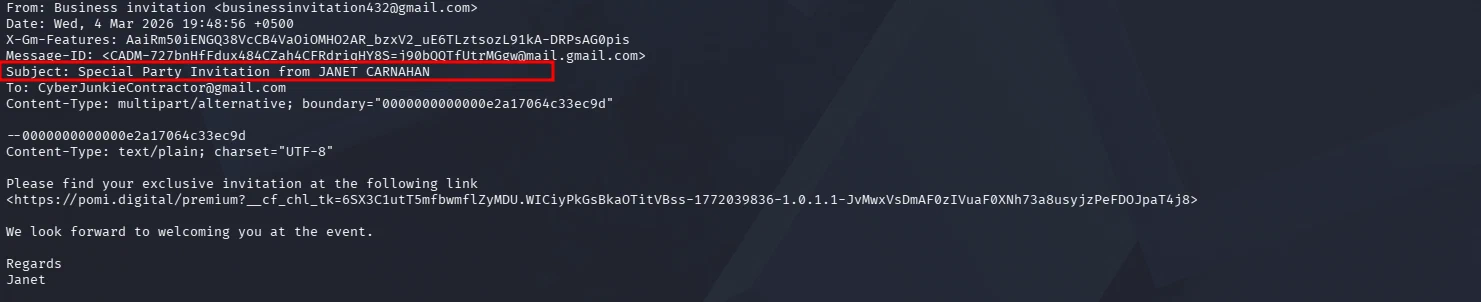
Detection angle. Mail-gateway or Exchange message-trace logs keyed on the subject line; a display name that does not match the envelope From is the tell.
3.3 Q2 — Malicious URI Redirect
Answer: https://pomi.digital/premium/windows_download.php
Method — Analyze the Edge browser history. The history database lives at:
C:\Users\CyberJunkie\AppData\Local\Microsoft\Edge\User Data\Default\History
Open it with DB Browser for SQLite and search the urls table. The user clicked the link in the phishing email → the browser navigated to the final download page → this navigation was recorded in the history table. This gives us the malicious redirect target (pomi.digital).
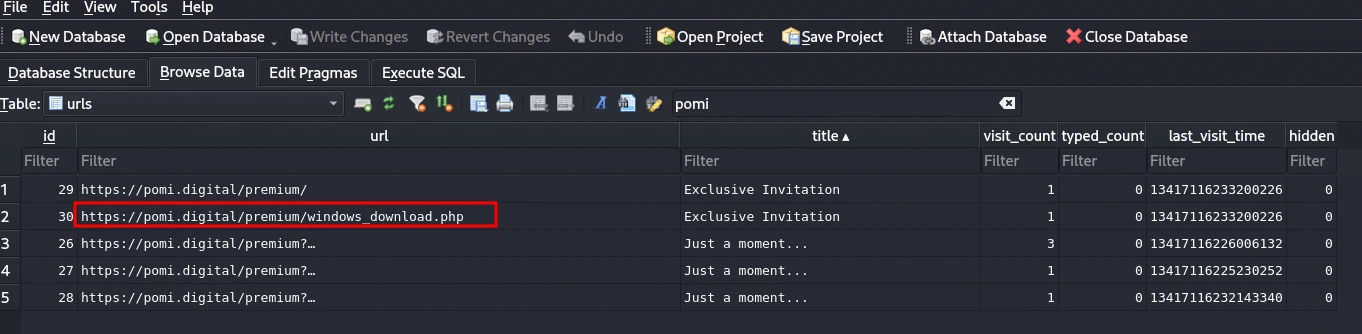
Detection angle. DNS or proxy logs for pomi.digital — a domain first seen 12 days before the click is the strongest single signal in this incident.
3.4 Q3 — Downloaded File Name
Answer: premium.exe
Method — In the same History database, downloads are recorded in the downloads_url_chains (or downloads) table. This is where we find the dropped file name premium.exe together with the URL it was downloaded from.
Tip: The downloads_url_chains table ties each download to its originating URL. The actual file name is stored in the target_path / current_path fields.
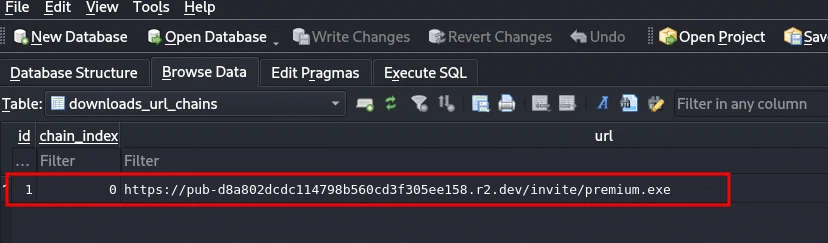
Detection angle. Sysmon EID 15 (FileCreateStreamHash) on Zone.Identifier for an .exe written under Downloads — catches browser-delivered executables with Mark-of-the-Web still attached.
3.5 Q4 — Malware Execution Time (Amcache)
Answer: 2026-03-04 16:44:33 UTC
Method — The Amcache.hve hive records program executions. I parsed it with RegRipper; the output shows the timestamp in epoch format 1772642673. Converting it yields 2026-03-04 16:44:33 UTC.
1772642673 → 2026-03-04 16:44:33 UTC

Note: Amcache is one of the most reliable sources for establishing when a binary actually executed on the system — a critical anchor for the attack timeline.
Detection angle. Amcache is post-hoc evidence. The live equivalent is Sysmon EID 1 with an Image ending in \Downloads\premium.exe.
3.6 Q5 — Malware SHA256 Hash
Answer: af240a2c2a4b42e3a130f47ccaab9aa2e20a1a586bc959ee9efd7475055ea7e3
Method — Amcache provides the MD5 hash (405481d3d5529445c546d4429b72c5827ebde840). Feed this MD5 into VirusTotal and you will easily recover the corresponding SHA256.
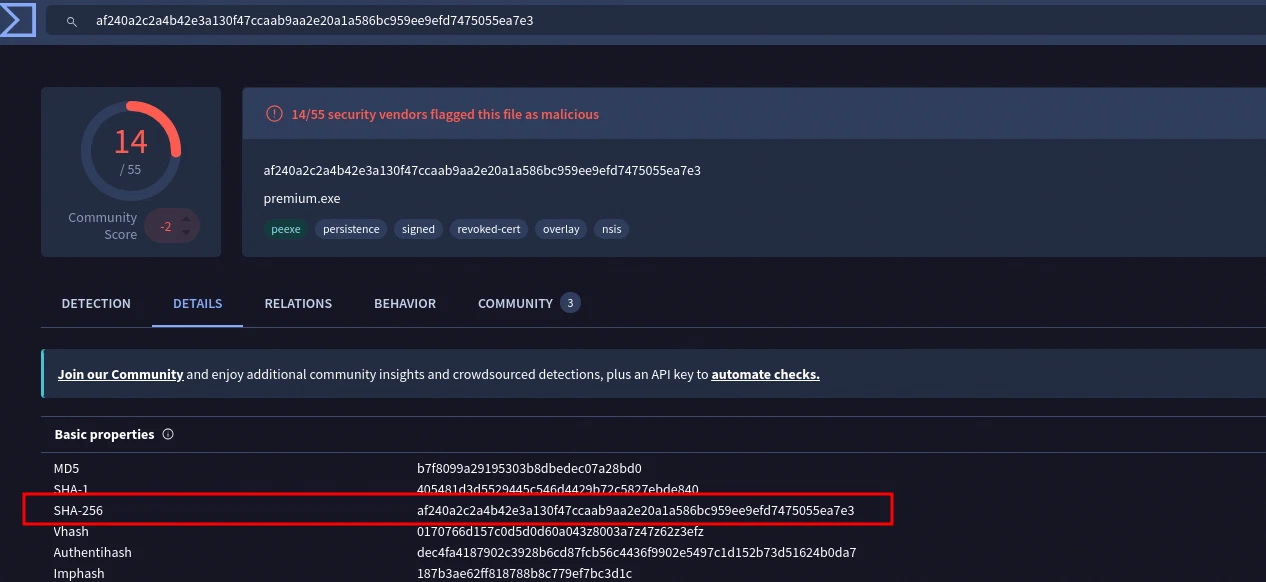
Tip: Amcache stores MD5 hashes. When a binary is known to VirusTotal, one hash fully identifies the family — so always pivot between hash formats.
Detection angle. Push the hash to EDR telemetry — a single match scopes every host that ever ran the sample.
3.7 Q6 — Microsoft Defender Scan Start Time
Answer: 2026-03-04T16:48:00
Method:
- First I checked
C:\ProgramData\Microsoft\Windows Defender\Support— nothing relevant there. - Then I dumped the Defender operational log with Chainsaw:
chainsaw dump "C:\Windows\System32\winevt\Logs\Microsoft-Windows-Windows Defender Operational.evtx" > defender.json
- Filter for Event ID 1000 (scan start):
cat ../Defender.json | jq '.[] | select(.Event.System.EventID == 1000)' | grep premium.exe -B 40
Event ID 1000 showed that the scan for premium.exe began at 2026-03-04T16:48:00. The user executed the file, nothing visibly happened, so they ran a manual Defender scan via the “Scan” button — this was captured as Event ID 1000.
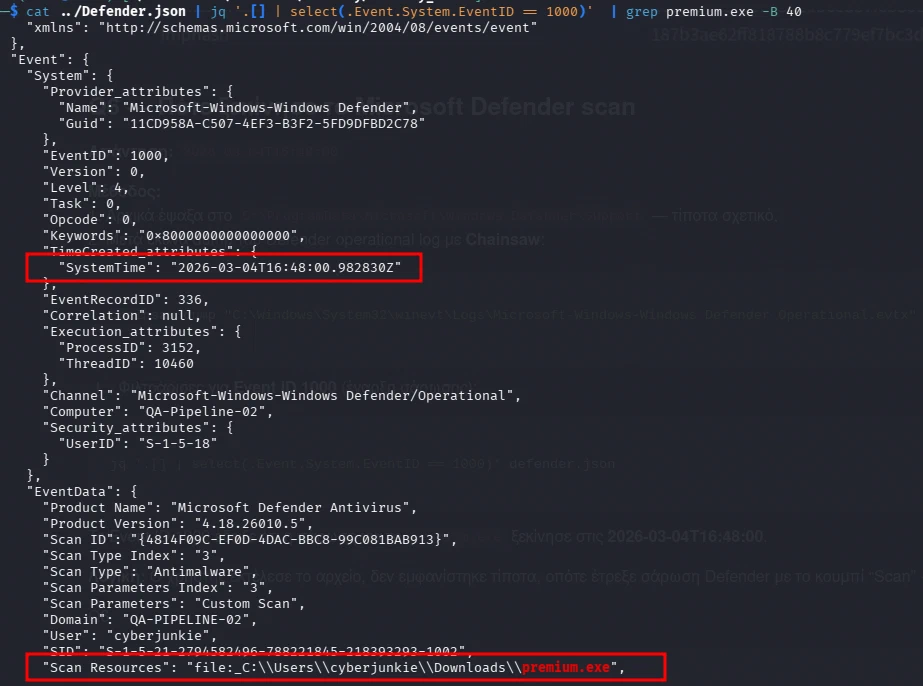
Detection angle. EID 1116/1117 would have fired on a detection. A 1000/1001 pair with no 1116 means the scan found nothing — that absence is itself the finding.
3.8 Q7 — RMM Backdoor Service Name
Answer: CentraStage
Method — Windows records every installation of a new service in System.evtx with Event ID 7045. Dump the log with Chainsaw and filter:
chainsaw dump "C:\Windows\System32\winevt\Logs\System.evtx" > system.json

jq -r '.[] | select(.Event.System.EventID == 7045) |
  [(.Event.System.TimeCreated_attributes.SystemTime), (.Event.EventData.ServiceName), (.Event.EventData.ImagePath)] |
  join(" ---> ")' system.json | grep "2026-03-04"

Note: CentraStage is a well-known RMM (Remote Monitoring & Management) tool — frequently leveraged by attackers as a backdoor for persistent remote access.
Detection angle. EID 7045 whose ImagePath sits under Program Files (x86) and belongs to no Microsoft product; correlate with 7036 for the service start.
3.9 Q8 — Modified Timestamp of RMM Executables (Timestamp Stomping)
Answer: 2026-02-09 07:56:40 UTC
Method — The Shimcache / AppCompatCache (stored in the SYSTEM hive) keeps execution-related timestamps. I analyzed the SYSTEM hive with RegRipper:
regripper -r Windows/System32/config/SYSTEM -aT | grep -i "centra"
1770623800|REG|||M... AppCompatCache - C:\Program Files (x86)\CentraStage\Gui.exe
1770623800|REG|||M... AppCompatCache - C:\Program Files (x86)\CentraStage\CagService.exe
1772644583|BAM|||\Device\HarddiskVolume3\Program Files (x86)\CentraStage\CagService.exe (S-1-5-18)
The epoch 1770623800 converts to 2026-02-09 07:56:40.

Warning: Timestamp stomping — The service was installed on 04/03, yet the modified timestamp reads 09/02 — three weeks earlier! The attacker backdated the files to look old and legitimate, obscuring the malware’s placement within the timeline. This timestamp inconsistency between install time and modified time is the key red flag.
Detection angle. Sysmon EID 2 (file creation time changed) is the direct signal. Without it, compare $STANDARD_INFORMATION against $FILE_NAME timestamps in the MFT — a mismatch is the tell.
3.10 Q9 — RMM Tool Company
Answer: Datto
Method — A simple web search. CentraStage is a product of Datto (Datto acquired CentraStage). Today it is also referred to as “Datto RMM”.
Tip: Common RMM tools abused in attacks include AnyDesk, TeamViewer, ScreenConnect, Atera, Splashtop, LogMeIn, and CentraStage/Datto RMM.
Detection angle. Inventory installed software: flag any RMM tool that is not on the approved list — Datto RMM, AnyDesk, ScreenConnect, Atera, Splashtop.
3.11 Q10 — Domain Registration Date
Answer: 2026-02-20 01:06:05
Method — WHOIS lookup for pomi.digital (GoDaddy WHOIS). The domain was registered ~2 weeks before the phishing campaign (04/03).
https://ie.godaddy.com/whois/results.aspx?domain=pomi.digital
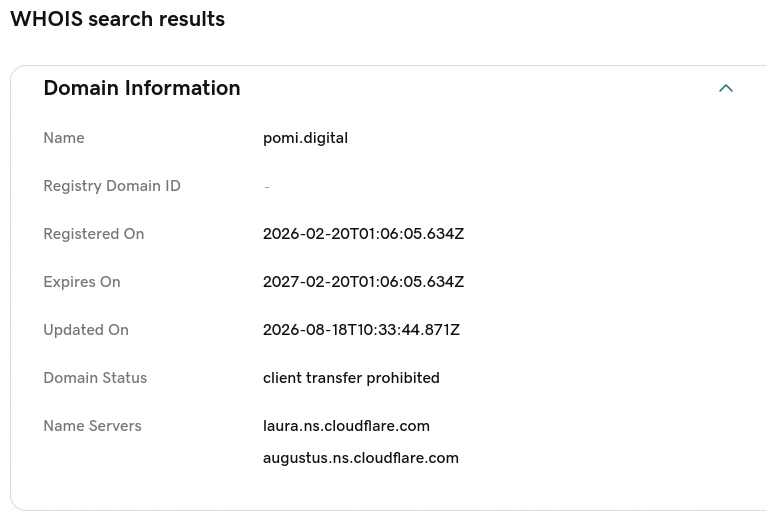
Warning: Freshly registered, low-reputation domains are a red flag — they are often bulk-created for phishing and fast-flux infrastructure, and they make excellent indicators of compromise (IOCs).
Detection angle. Enrich every first-seen domain with registration age and alert below 30 days at the mail gateway and the proxy.
3.12 Q11 — Malware Alternative Name
Answer: 5bxrx.exe
Method — On the VirusTotal details page for SHA256 af240a2c2a..., the “Names” section lists every file name under which the malware has been observed. 5bxrx.exe is one of those.
Tip: Malware samples accumulate many names from different sources (sandboxes, AV vendors, other campaigns). Every one of them is a valid IOC for hunting across your environment.
Detection angle. Push every known alias to EDR filename telemetry and re-check the AV exclusion list for the same names.
4. Challenge Q&A Log
| # | Question | Answer | Method |
|---|---|---|---|
| 1 | Phishing email subject | Special Party Invitation from JANET CARNAHAN |
EML headers |
| 2 | Malicious URI redirect | https://pomi.digital/premium/windows_download.php |
Edge History → urls |
| 3 | Downloaded file name | premium.exe |
Edge History → downloads_url_chains |
| 4 | Malware execution time (Amcache) | 2026-03-04 16:44:33 UTC |
Amcache.hve via RegRipper |
| 5 | Malware SHA256 hash | af240a2c2a4b42e3a130f47ccaab9aa2e20a1a586bc959ee9efd7475055ea7e3 |
MD5 from Amcache → VirusTotal |
| 6 | Defender scan start time | 2026-03-04T16:48:00 |
Defender Operational EID 1000 |
| 7 | RMM backdoor service name | CentraStage |
System.evtx EID 7045 |
| 8 | Modified timestamp (timestomping) | 2026-02-09 07:56:40 UTC |
Shimcache / AppCompatCache |
| 9 | RMM tool company | Datto |
OSINT |
| 10 | Domain registration date | 2026-02-20 01:06:05 |
GoDaddy WHOIS |
| 11 | Malware alternative name | 5bxrx.exe |
VirusTotal names |
5. Incident Narrative
The intrusion started twelve days before the victim saw anything. On 2026-02-20 at 01:06 UTC someone registered pomi.digital through GoDaddy — a domain with no history, no content and no purpose other than to host the next step.
On 2026-03-04 at 14:48 UTC an email titled Special Party Invitation from JANET CARNAHAN arrived in CyberJunkie’s inbox. The display name promised a party; the link went to https://pomi.digital/premium/windows_download.php. Edge’s history shows the click, the redirect and the download that followed: premium.exe, saved to the Downloads folder.
For almost two hours nothing happened. Then at 16:44:33 UTC the binary executed — recorded in Amcache, which is how the moment can be pinned to the second. Twelve seconds later, at 16:44:45, Windows logged Event ID 7045: a new service called CentraStage had been installed from C:\Program Files (x86)\CentraStage\. CentraStage is Datto RMM — legitimate remote-management software, repurposed as a backdoor. From that point the attacker had a persistent remote channel into the host that would survive a reboot and blend into a software inventory.
At 16:48:00, just over three minutes after the service was installed, the victim ran a manual Defender scan. The operational log shows a scan start and a scan finish, but no detection event: the malware was already resident and the scan had nothing to match against.
What the attacker left behind was an attempt at cover. The CentraStage binaries carry a modified timestamp of 2026-02-09 07:56:40 UTC — three weeks before the service was installed, and eleven days before pomi.digital was even registered. A file cannot be older than the infrastructure it arrived from. That single inconsistency is what turns a routine “suspicious download” into a deliberate timestomping case.
The host was then triaged with KAPE and handed over. Everything above was reconstructed from six artifacts: one email, one SQLite database, two registry hives and two event logs.
6. Attack Timeline
| Timestamp (UTC) | Event | Artifact | ATT&CK |
|---|---|---|---|
| 2026-02-09 07:56:40 | (stomped) modified timestamp on CentraStage binaries | Shimcache | T1070.006 |
| 2026-02-20 01:06:05 | pomi.digital domain registered |
WHOIS | T1583.001 |
| 2026-03-04 14:48 | Phishing email sent | EML headers | T1566.002 |
| 2026-03-04 ~14:48 | User clicks link → redirect | Edge History | T1566.002 |
| 2026-03-04 ~14:48 | premium.exe downloaded |
Edge downloads | T1105 |
| 2026-03-04 16:44:33 | premium.exe executed |
Amcache | T1204.002 |
| 2026-03-04 16:44:45 | CentraStage service installed |
System.evtx (7045) | T1543.003 |
| 2026-03-04 16:48:00 | Defender manual scan starts | Defender Operational (1000) | — |
Note: Note on the timeline: register the domain (02/20) → stomp timestamps (02/09) → phish (03/04) → execute (03/04) → persist (03/04) → scan (03/04). The sequence of events is consistent with a pre-staged C2 domain and an attacker who actively tried to hide their persistence.
7. Indicators of Compromise (IOCs)
7.1 File IOCs
| Type | Value | Context |
|---|---|---|
| SHA256 | af240a2c2a4b42e3a130f47ccaab9aa2e20a1a586bc959ee9efd7475055ea7e3 |
premium.exe — Q5 |
| MD5 | 405481d3d5529445c546d4429b72c5827ebde840 |
Amcache record for premium.exe — Q5 |
| File Name | premium.exe |
Dropper downloaded from the phishing link — Q3 |
| File Name | 5bxrx.exe |
Alternative name observed on VirusTotal — Q11 |
| File Path | C:\Program Files (x86)\CentraStage\ |
Persistence directory, timestomped — Q8 |
7.2 Network IOCs
| Type | Value | Context |
|---|---|---|
| Domain | pomi.digital |
Redirect and payload host, registered 2026-02-20 — Q2, Q10 |
| URL | https://pomi.digital/premium/windows_download.php |
Payload delivery — Q2 |
7.3 Behavioral IOCs
| Type | Value | Context |
|---|---|---|
| Service | CentraStage |
RMM backdoor installed as a Windows service — Q7 |
| Email Subject | Special Party Invitation from JANET CARNAHAN |
Phishing lure — Q1 |
| Timestamp Anomaly | Modified time 2026-02-09 on files installed 2026-03-04 | Timestomping — Q8 |
| Log Absence | Defender scan at 16:48:00 with no detection event | Evasion success — Q6 |
8. Detection Opportunities
| Source | What to look for | Why it matters |
|---|---|---|
| Proxy / DNS | Resolutions to domains registered in the last 30 days | pomi.digital was 12 days old at delivery |
| Sysmon EID 1 / Security 4688 | premium.exe executed from \Downloads\ |
Execution of the dropper |
| Sysmon EID 15 | .exe written with Zone.Identifier under Downloads |
Browser-delivered payload with MOTW |
| System.evtx EID 7045 | New service with ImagePath under Program Files (x86) |
RMM persistence |
| Sysmon EID 13 / registry | HKLM\SYSTEM\CurrentControlSet\Services\CentraStage |
Service registration |
| Sysmon EID 2 | File creation time changed | Timestomping |
| Defender Operational EID 1000/1001 | Scan started and finished with no 1116 | Manual scan that found nothing |
| Software inventory | Unapproved RMM (Datto RMM, AnyDesk, ScreenConnect, Atera) | Dual-use tooling |
9. MITRE ATT&CK Mapping
| TTP ID | Tactic | Technique | Evidence |
|---|---|---|---|
| T1583.001 | Resource Development | Acquire Infrastructure: Domains | pomi.digital registered 2026-02-20 |
| T1566.002 | Initial Access | Phishing: Spearphishing Link | Email with a redirect to pomi.digital |
| T1204.002 | Execution | User Execution: Malicious File | premium.exe executed 2026-03-04 16:44:33 |
| T1543.003 | Persistence | Create or Modify System Process: Windows Service | CentraStage service, EID 7045 |
| T1070.006 | Defense Evasion | Indicator Removal: Timestomp | Modified time three weeks before install |
| T1105 | Command and Control | Ingress Tool Transfer | premium.exe downloaded from pomi.digital |
| T1219 | Command and Control | Remote Access Software | Datto RMM / CentraStage |
10. Conclusions & Recommendations
10.1 Incident Summary
| What Happened | A user executed a phishing-delivered binary, which installed Datto RMM as a Windows service within twelve seconds, giving the attacker a persistent remote channel. |
|---|---|
| Root Cause | Spearphishing link leading to user execution of premium.exe from the Downloads folder; no application control or reputation check intercepted it. |
| Impact Assessment | Confidentiality: High — RMM gives remote access to the host and the logged-on user’s context. Integrity: High — the binaries were modified on disk to backdate their timestamps. Availability: Medium — no destructive action observed, but remote control permits it. |
10.2 Recommendations
| Priority | Timeframe | Recommendation |
|---|---|---|
| Immediate | Within 24h | Block pomi.digital at DNS and proxy; hunt the SHA256, premium.exe and 5bxrx.exe across the estate |
| High | Within 7 days | Remove the CentraStage service from any host that should not have it; audit the RMM inventory |
| Medium | Within 30 days | Alert on EID 7045 for services outside an approved list; enable Sysmon EID 2 to catch timestomping |
| Low | Within 90 days | Enforce Mark-of-the-Web handling for browser downloads; phishing awareness for the delivery pattern |
| Strategic | Ongoing | Build detection content for RMM abuse and timestamp inconsistency, not just file hashes |
11. Analyst Notes & Learning
11.1 What I Did Well
Anchored every stage of the attack to a specific artifact before drawing a conclusion, so the timeline is reproducible rather than remembered.
11.2 Key Takeaways
- Follow the natural attack flow: email → browser → execution → persistence. Anchoring each stage to an artifact builds a solid timeline.
- Amcache for execution evidence, Shimcache/AppCompatCache for timestamps.
- Event ID 7045 = new service → always check for RMM tools when you see it.
- Timestamp inconsistencies (modified earlier than install/created) = red flag for timestomping.
- Freshly registered domains (< 30 days old) are suspicious infrastructure.
- VirusTotal provides all hashes and alternative file names for a sample — pivot to it early.
11.3 New Techniques
Pivoting MD5 from Amcache to SHA256 through VirusTotal, and using WHOIS registration age as a first-class triage signal.