Solved Lupin from Hack The Box!
| Field | Details |
|---|---|
| Case Reference | HTB-SHRLCK-LUPIN |
| Platform | Hack The Box — Sherlock |
| Category | Malware Analysis — Windows Dropper (Reverse Engineering) |
| Difficulty | Medium |
| Date Opened | — |
| Severity | High |
| Status | In Progress — training scenario |
| Artifact | Malicious executable optimize.exe |
| Tools | diec, Cutter (rizin), strings |
Scenario: After a security incident, unusual activity on Samira’s workstation led to the discovery of a suspicious binary operating stealthily in the background. The executable evades standard detection while maintaining persistence and network communication. Your mission is to reverse the binary and extract the attacker’s TTPs for the endpoint security team.
1. Executive Summary
A native C PE binary (optimize.exe) was recovered from Samira’s workstation. Static analysis with diec shows it is not packed (overall entropy 6.4145). The binary masquerades using the filename syscrondvr.exe (mimicking a system driver service), performs region-based execution checks via GetLocaleInfoA, and evades sandbox analysis with Sleep(1000ms) loops and DeleteUrlCacheEntry (purging the Windows Internet cache before fetching from C2). The C2 URL is constructed dynamically with wsprintfA using a hardcoded array at 0x414310. The lab is currently incomplete (Q5 has no recorded answer).
1.1 Incident Summary
| Field | Details |
|---|---|
| Incident Type | Stealthy Windows dropper (masquerading + locale check + cache evasion) |
| Initial Access | Suspicious binary on Samira’s workstation |
| Discovery | Unusual background activity on the endpoint |
| Malware | optimize.exe (native C PE, not packed) |
| Overall Severity | High |
1.2 Key Findings
- Entropy:
6.41450— not packed (below the 7.0 packing threshold). - Consistent replication filename:
syscrondvr.exe(4 call sites pushingstr.syscrondvr.exe). - Region-based execution constraint:
GetLocaleInfoA(system language/locale check). - C2 cache evasion:
DeleteUrlCacheEntry(purges cached responses before fetching). - C2 URL built dynamically with
wsprintfAusing a hardcoded array at0x414310. - Sandbox evasion: nested
Sleep(1000ms)loops to outlast sandbox timeouts. - Q5 is incomplete — no recorded answer.
2. Investigation Scope & Artifacts
2.1 Artifacts Analyzed
| Artifact | Format | What it answers |
|---|---|---|
optimize.exe |
Native C PE (not packed) | All questions Q1–Q5 |
2.2 Tools & Methods
| Tool | Purpose |
|---|---|
diec (-e entropy flag) |
Entropy analysis / packing detection |
| Cutter (rizin) | Reverse engineering (strings, X-Refs, disassembly) |
strings |
Static string extraction (locale keywords) |
3. Technical Analysis
3.1 Scenario
Reverse engineering a stealthy Windows dropper. The binary evades standard detection while maintaining persistence and network communication. Objective: extract the attacker’s TTPs for the endpoint security team.
3.2 Q1 — What is the entropy value of the executable file?
Answer: 6.41450
To determine whether the binary was packed or obfuscated, we calculated its entropy using diec with the -e (entropy) flag. Entropy measures randomness in a file’s byte distribution — values above 7.0 typically indicate packing or encryption, while values below that suggest readable, unobfuscated content.
$ diec -e optimize.exe
Total 6.4145: not packed
  0|PE Header|0|1024|2.29117: not packed
  1|Section(0)['.text']|1024|59392|6.11097: not packed
  2|Section(1)['.rdata']|60416|14336|5.60578: not packed
  3|Section(2)['.data']|74752|7168|5.67993: not packed
The overall entropy of 6.4145 falls below the packing threshold, and diec confirms not packed across all sections. The .text section (executable code) sits at 6.11097, consistent with compiled native code. No section shows suspiciously high entropy, meaning the binary is unlikely to be compressed or encrypted — we can proceed with static analysis directly.
Detection angle. diec -e entropy per section — packing/obfuscation detection.
3.3 Q2 — What is the consistent filename used by the malware when replicating itself across different locations?
Answer: syscrondvr.exe
Since the binary is a native C PE, we opened it in Cutter and searched for CreateFileW — the Windows API used to create or open files. To find what filename is passed to it, we searched all strings in the binary and identified syscrondvr.exe as a candidate. Cross-referencing it via X-Refs revealed 4 separate call sites all pushing str.syscrondvr.exe as an argument, confirming this is the hardcoded filename the malware consistently uses when copying itself to different locations. The code preview also shows calls to GetModuleFileNameW, PathFindFileNameW, and ExpandEnvironmentStringsW nearby — indicating the malware resolves target paths dynamically before dropping the copy.
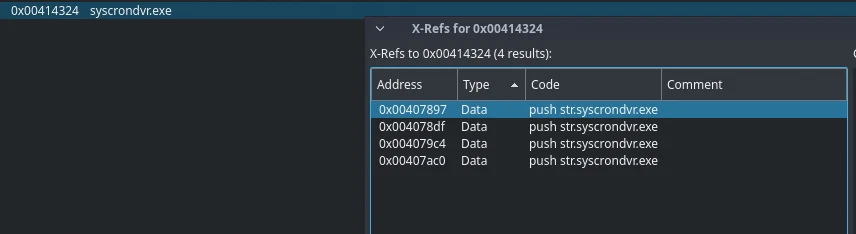
MITRE ATT&CK: T1036.005 — Masquerading: Match Legitimate Name or Location (filename mimics a legitimate-sounding system driver service).
Detection angle. Cutter X-Refs on str.syscrondvr.exe — confirms hardcoded replication filename across 4 call sites.
3.4 Q3 — Following filename verification, which Win32 API does the binary use to enforce region-based execution constraints?
Answer: GetLocaleInfoA
After identifying the self-replication filename in Q2, we continued static analysis in Cutter by searching the strings panel for locale-related keywords. Searching for local surfaced GetLocaleInfoA in the binary’s referenced strings — a Win32 API used to retrieve locale information for a given locale identifier. Its presence indicates the malware performs a region check at runtime, likely comparing the system’s locale against a hardcoded target value and altering execution behavior (continuing, exiting, or sleeping) based on the result.
Also can use strings:
strings optimize.exe | grep -i 'locale'
GetLocaleInfoA
MITRE ATT&CK: T1614.001 — System Location Discovery: System Language Discovery (adversaries query locale/language settings to determine whether they are operating in a targeted or safe region).
Detection angle. strings grep for locale/GetLocaleInfoA — region-based execution gating.
3.5 Q4 — The function at relative address 0x407680 makes a WinAPI call immediately before initiating the network request. Which WinAPI function does it call to ensure fresh data is retrieved from the C2 server?
Answer: DeleteUrlCacheEntry
We navigated directly to address 0x407680 in Cutter and scrolled through the function body. The function opens with two nested loops calling Sleep(1000ms) — an evasion technique to outlast sandbox timeouts. It then dynamically constructs a C2 URL using wsprintfA with a format string and domain values pulled from a hardcoded array at 0x414310. Immediately before the network request is initiated, the malware calls DeleteUrlCacheEntry on the freshly built URL, purging any cached response from the Windows Internet cache and forcing a live fetch from the C2 server.
0x00407757      call    dword [wsprintfA]        ; build C2 URL string
0x00407767      call    dword [DeleteUrlCacheEntry] ; purge cache before fetch
MITRE ATT&CK: T1071.001 (Application Layer Protocol: Web Protocols — C2 over HTTP) | T1497.003 (Virtualization/Sandbox Evasion: Time Based Evasion — Sleep loops).
Detection angle. DeleteUrlCacheEntry before a network fetch — C2 cache-evasion technique.
3.6 Q5 — Samira noticed unusual behavior during the paste operation. What is the relative address of the function responsible for this strange activity?
Answer: (not recorded — lab incomplete)
The original walkthrough ends here without a recorded answer. The question refers to unusual behavior during a paste operation, likely a clipboard-monitoring or keylogging routine in the binary. This Q would require further reverse engineering of the binary in Cutter (searching for clipboard APIs such as OpenClipboard, GetClipboardData, etc.).
Detection angle. Clipboard API calls (OpenClipboard, GetClipboardData) in a binary — potential keylogger/clipboard stealer.
4. Challenge Q&A Log
| # | Question | Answer | Method |
|---|---|---|---|
| 1 | Entropy value of the executable | 6.41450 |
diec -e |
| 2 | Consistent replication filename | syscrondvr.exe |
Cutter strings + X-Refs |
| 3 | Win32 API for region-based execution constraints | GetLocaleInfoA |
Cutter strings panel |
| 4 | WinAPI called before network request (cache evasion) | DeleteUrlCacheEntry |
Cutter disassembly at 0x407680 |
| 5 | Relative address of function responsible for paste behavior | (not recorded) | (incomplete) |
5. Incident Narrative
A stealthy Windows dropper (optimize.exe) was discovered on Samira’s workstation. The binary is not packed (entropy 6.4145), masquerades using the filename syscrondvr.exe, performs region-based execution checks via GetLocaleInfoA, and evades sandbox analysis with Sleep(1000ms) loops and DeleteUrlCacheEntry (purging the Windows Internet cache before fetching from C2). The C2 URL is constructed dynamically with wsprintfA using a hardcoded array at 0x414310. The lab is currently incomplete (Q5 has no recorded answer).
6. Attack Timeline
| Timestamp (UTC) | Event | Artifact | ATT&CK |
|---|---|---|---|
| (runtime) | Binary executed (not packed, entropy 6.4145) | diec -e |
— |
| (runtime) | Region check via GetLocaleInfoA |
Cutter strings | T1614.001 |
| (runtime) | Sleep(1000ms) loops (sandbox evasion) |
Cutter disassembly | T1497.003 |
| (runtime) | DeleteUrlCacheEntry purges cache before C2 fetch |
Cutter disassembly | T1497.003 |
| (runtime) | C2 URL built with wsprintfA (array at 0x414310) |
Cutter disassembly | T1071.001 |
| (runtime) | Self-replication as syscrondvr.exe (4 call sites) |
Cutter X-Refs | T1036.005 |
7. Indicators of Compromise (IOCs)
7.1 File IOCs
| Type | Value | Context |
|---|---|---|
| File Name | optimize.exe |
Original malicious binary |
| File Name | syscrondvr.exe |
Hardcoded replication filename (masquerading) — Q2 |
7.2 Network IOCs
| Type | Value | Context |
|---|---|---|
| C2 URL | Built dynamically with wsprintfA (array at 0x414310) |
C2 communication — Q4 |
7.3 Behavioral IOCs
| Type | Value | Context |
|---|---|---|
| API | GetLocaleInfoA |
Region-based execution gating — Q3 |
| API | DeleteUrlCacheEntry |
C2 cache evasion — Q4 |
| API | wsprintfA |
Dynamic C2 URL construction — Q4 |
| API | Sleep(1000ms) (nested loops) |
Sandbox time-based evasion — Q4 |
| Entropy | 6.41450 (not packed) |
Binary is unobfuscated — Q1 |
8. Detection Opportunities
| Source | What to look for | Why it matters |
|---|---|---|
| Static analysis | Entropy < 7.0 but presence of suspicious APIs (GetLocaleInfoA, DeleteUrlCacheEntry) |
Dropper with region checks and cache evasion |
| Strings analysis | Hardcoded filename syscrondvr.exe in a binary |
Masquerading replication filename — Q2 |
| Disassembly | Sleep loops before network activity |
Sandbox time-based evasion — Q4 |
| Disassembly | DeleteUrlCacheEntry before HTTP fetch |
C2 cache-evasion technique — Q4 |
| Disassembly | wsprintfA with hardcoded array for URL construction |
Dynamic C2 URL building — Q4 |
9. MITRE ATT&CK Mapping
| TTP ID | Tactic | Technique | Evidence |
|---|---|---|---|
| T1036.005 | Defense Evasion | Masquerading: Match Legitimate Name or Location | syscrondvr.exe replication filename — Q2 |
| T1614.001 | Discovery | System Location Discovery: System Language Discovery | GetLocaleInfoA region check — Q3 |
| T1071.001 | Command and Control | Application Layer Protocol: Web Protocols | C2 via HTTP (wsprintfA URL) — Q4 |
| T1497.003 | Defense Evasion | Virtualization/Sandbox Evasion: Time Based Evasion | Sleep(1000ms) loops — Q4 |
10. Conclusions & Recommendations
10.1 Incident Summary
| What Happened | A stealthy Windows dropper (optimize.exe) was discovered on Samira’s workstation. It is not packed, masquerades as syscrondvr.exe, performs region-based execution checks, and evades sandbox analysis with Sleep loops and cache purging before fetching from C2. |
|---|---|
| Root Cause | Malicious binary executed on the endpoint; no application control or sandbox caught the region checks and cache evasion. |
| Impact Assessment | Confidentiality: High — C2 communication and potential data exfiltration. Integrity: Medium — self-replication as syscrondvr.exe. Availability: Low — no destructive action observed. |
10.2 Recommendations
| Priority | Timeframe | Recommendation |
|---|---|---|
| Immediate | Within 24h | Isolate the host; hunt syscrondvr.exe across the estate; block the C2 domain (once recovered from the 0x414310 array) |
| High | Within 7 days | Submit optimize.exe to a sandbox with locale variation and extended timeout to defeat the Sleep/cache evasion |
| Medium | Within 30 days | Alert on DeleteUrlCacheEntry + network fetch in the same process; alert on GetLocaleInfoA in non-localized binaries |
| Low | Within 90 days | Application control (allow-list) for executables; user awareness |
| Strategic | Ongoing | Document reverse engineering workflow for native C PEs; complete Q5 analysis (clipboard monitoring) |
11. Analyst Notes & Learning
11.1 What I Did Well
Used diec for entropy analysis to confirm the binary was not packed before diving into static analysis. Anchored Cutter’s Strings panel on the CreateFileW/syscrondvr.exe string to find the replication logic. Identified the DeleteUrlCacheEntry cache-evasion technique by reading disassembly at 0x407680.
11.2 Key Takeaways
- Entropy < 7.0 doesn’t mean safe — the binary can still be malicious with region checks and cache evasion.
GetLocaleInfoAis a common anti-analysis technique — malware checks the system locale and exits if it doesn’t match the target region.DeleteUrlCacheEntrybefore a network fetch forces a live C2 request, defeating cache-based analysis.Sleeploops (1000ms × nested) outlast short sandbox timeouts.- Masquerading filenames (
syscrondvr.exe) mimic legitimate system services. - Q5 is incomplete — further reverse engineering needed (clipboard APIs).
11.3 New Techniques
diec entropy analysis, Cutter reverse engineering (strings, X-Refs, disassembly at specific addresses), GetLocaleInfoA region-check identification, and DeleteUrlCacheEntry cache-evasion analysis.
12. References
- Lupin — Hack The Box Sherlock
- MITRE ATT&CK — T1036.005 Masquerading
- MITRE ATT&CK — T1614.001 System Location Discovery
- MITRE ATT&CK — T1071.001 Web Protocols
- MITRE ATT&CK — T1497.003 Time Based Evasion
- diec — Detect It Easy
- Cutter (rizin)
HTB Sherlock · Lupin · Malware Analysis · 2026-03-25