| Field | Details |
|---|---|
| Case Reference | HTB-SHRLCK-GHOSTTRACE |
| Platform | Hack The Box — Sherlock |
| Category | DFIR — Active Directory |
| Difficulty | — |
| Date Opened | 2026-01-07 |
| Severity | Critical |
| Status | Closed — training scenario |
| Hosts | Client02 · Client03 · DC01 |
| Stack | Windows Event Logs · Sysmon · Splunk · Hayabusa · Chainsaw |
1. Executive Summary
On 2025-05-25 a single phishing email carrying a macro-enabled Word document (Profits.docm) reached a user on Client02 and, in under forty minutes, became a full domain compromise of Main.local. The attacker moved from initial access through Kerberoasting, Pass-the-Hash, LSASS credential dumping, DCSync and Domain Admin authentication, finishing with triple persistence on the Domain Controller. Every step is reconstructable from standard Windows telemetry — Sysmon (IDs 1, 3, 10, 11, 15, 22), PowerShell Script Block Logging (ID 4104) and Windows Security events (4624, 4662, 4769) — and was confirmed with Splunk and Hayabusa/Timeline Explorer.
This report walks the intrusion end to end: sixteen challenge questions, each anchored to the exact Splunk query and artifact that proves the answer, followed by a consolidated timeline, indicators of compromise, detection opportunities, MITRE ATT&CK mapping and recommendations.
1.1 Incident Summary
| Field | Details |
|---|---|
| Incident Type | Phishing → Active Directory domain takeover |
| Initial Access | Spearphishing attachment — macro-enabled Word document (Profits.docm) |
| Discovery | Blue team investigation of a suspected breach in Main.local |
| First Execution | 2025-05-25 03:28:58 UTC (macros enabled on Client02) |
| Persistence | Triple: Windows service WindowsUpdateSvc, scheduled task WindowsUpdateCheck, registry Run key xcvafctr — all pointing at scvhost.exe on DC01 |
| Overall Severity | Critical — full domain compromise in under 40 minutes |
1.2 Key Findings
- The lure was
Profits.docm, downloaded from192.168.204.152and confirmed via Sysmon ID 15Zone.Identifier(HostUrl). - The macro opened a Meterpreter reverse shell to
192.168.204.152:4444six seconds after macros were enabled, then a second channel on port1337viaUpdatePolicy.exe. - PowerView was loaded entirely in memory (PowerShell ID 4104, 70 script blocks, PID 7924) to enumerate SPN accounts;
sqlsvcwas Kerberoasted and its hash cracked in ~26 minutes. - The attacker pivoted to
Client03assqlsvc, ran PsExec (VgYTbFEK.exe), dumped LSASS with mimikatz renamed tonetdiag.exe, and performed DCSync againstDC01at 04:26:36 UTC. - Domain Admin access was achieved at 04:36:01 UTC using the replicated
Administratorhash. - Three independent persistence mechanisms were installed on
DC01within seven minutes, all pointing at the typosquatted binaryscvhost.exe.
2. Investigation Scope & Artifacts
2.1 Artifacts Analyzed
| Artifact | Format | What it answers |
|---|---|---|
ghostrace_dump_all.json |
JSON (Splunk index main) |
All Windows/Sysmon/PowerShell events ingested from Client02, Client03, DC01 — Q01–Q16 |
Client02 Windows Security log |
EVTX | Logon events (4624), Kerberos tickets (4769) |
Client02 Sysmon operational log |
EVTX | Process creation (1), network (3), file create (11), ADS (15), DNS (22) |
Client03 Windows Security + Sysmon |
EVTX | PsExec lateral movement, LSASS access (10), credential dumping |
DC01 Windows Security + Sysmon |
EVTX | DCSync (4662), Domain Admin logon, persistence creation |
| PowerShell Operational log | EVTX | Script Block Logging (4104) — fileless PowerView execution |
| Hayabusa / Timeline Explorer output | CSV/Timeline | Automated detection of Pass-the-Hash and DCSync (Q11, Q12) |
2.2 Tools & Methods
| Tool | Purpose |
|---|---|
| Splunk | Ingesting ghostrace_dump_all.json and running the queries in §3 |
| Hayabusa | Automated rule-based detection (Pass the Hash Activity 2, Mimikatz DC Sync) |
| Timeline Explorer | Visualising the Hayabusa timeline and confirming Q11/Q12 timestamps |
| Chainsaw | Dumping and searching EVTX logs offline |
| PowerShell | Extracting and filtering JSON event data |
2.3 Event ID Reference
| Source | ID | Description | Security Context |
|---|---|---|---|
| Windows | 4624 |
Successful Logon | Check Logon Type — 2=local, 3=network, 9=runas/netonly, 10=RDP |
| Windows | 4634 |
Logoff | Session duration; match with 4624 |
| Windows | 4662 |
Object Operation | DCSync detection — check for replication GUIDs |
| Windows | 4672 |
Special Privileges Assigned | Admin-level logon confirmation |
| Windows | 4688 |
New Process Created | Full command-line tracking |
| Windows | 4689 |
Process Terminated | Match with 4688 for duration |
| Windows | 4738 |
User Account Changed | Password resets, persistence |
| Windows | 4769 |
Kerberos Service Ticket Requested | Kerberoasting / Silver Ticket — check encryption type |
| Windows | 4776 |
NTLM Authentication | DC credential validation |
| Windows | 5322 |
Account Locked Out | Brute force / password spray |
| PShell | 4103 |
Module Logging | Pipeline execution details (verbose) |
| PShell | 4104 |
Script Block Logging | Critical — records actual PS code executed |
| Sysmon | 1 |
Process Creation | Parent process, full cmdline, file hash |
| Sysmon | 3 |
Network Connection | Maps PID → IP:Port |
| Sysmon | 5 |
Process Terminated | Match with ID 1 for execution duration |
| Sysmon | 7 |
Image Loaded | DLL loads — detect injection and side-loading |
| Sysmon | 10 |
Process Access | LSASS access — credential dumping detection |
| Sysmon | 11 |
File Create | When and where a file was written to disk |
| Sysmon | 12/13/14 |
Registry Events | Object create/delete, value set, rename — persistence detection |
| Sysmon | 15 |
FileCreateStreamHash (ADS) | MotW tracking — HostUrl present = download complete |
| Sysmon | 22 |
DNS Query | Process DNS resolution — C2 and lateral movement detection |
3. Technical Analysis
3.1 Scenario
Blue team investigation of a suspected breach in an Active Directory environment named Main.local. The network includes a Domain Controller (DC01) and two client machines (Client02, Client03). A user on Client03’s neighbouring host Client02 received a phishing email leading to a series of attacks that compromised the domain. Objective: reconstruct the attack chain, identify attacker actions, and uncover credentials, hashes, and persistence mechanisms using Windows Event Logs and Sysmon logs.
3.2 Q01 — What is the name of the malicious phishing attachment downloaded by the user on Client02?
Answer: Profits.docm
Method — Sysmon ID 15 (FileCreateStreamHash) fires on every ADS write. The HostUrl field only appears in the Zone.Identifier once the download is complete — this event confirms both the filename and the source URL.
Splunk Query:
source="ghostrace_dump_all.json" host="parrot" sourcetype="_json"
"Event.System.Computer"="Client02.Main.local"
Event.System.EventID=15
"Event.System.Channel"="Microsoft-Windows-Sysmon/Operational"
| table Event.EventData.UtcTime, Event.EventData.Image,
        Event.EventData.TargetFilename,
        Event.EventData.Contents, Event.EventData.User
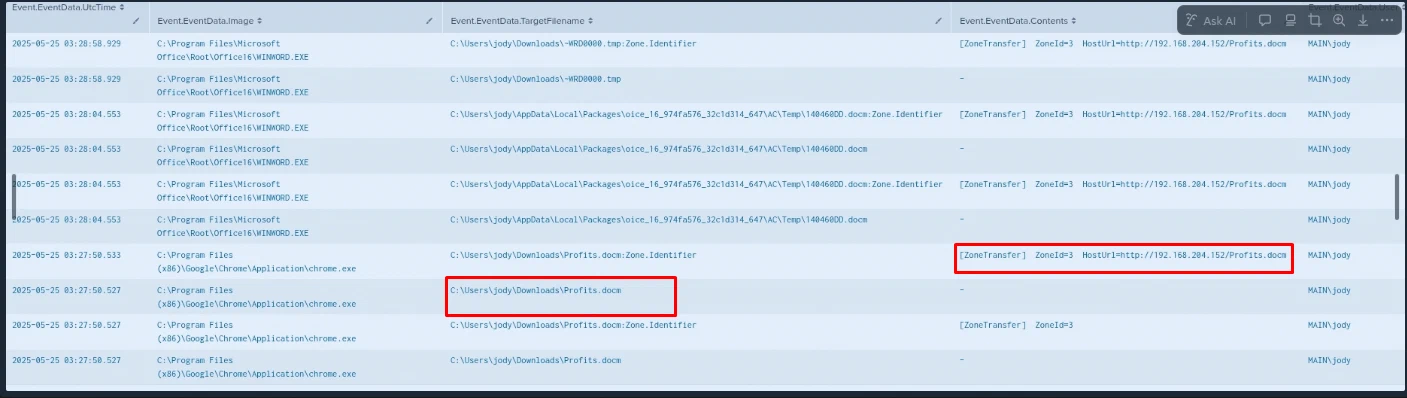
Notes: Sysmon ID 15 (FileCreateStreamHash) fires on every ADS write. The HostUrl field only appears in the Zone.Identifier once the download is complete — this is the event that confirms both the filename and the source URL.
Detection angle. Sysmon EID 15 with a HostUrl ADS on a .docm/.doc under Downloads — confirms a browser-delivered Office document and exposes the source URL.
3.3 Q02 — What is the IP address from which the malicious attachment was downloaded?
Answer: 192.168.204.152
Method — The answer is embedded in the Zone.Identifier ADS contents from Q01. Use rex to extract the HostUrl field cleanly — the URL contains the full source IP.
Splunk Query:
source="ghostrace_dump_all.json" host="parrot" sourcetype="_json"
"Event.System.Computer"="Client02.Main.local" Event.System.EventID=15
| rex field=Event.EventData.Contents "HostUrl=(?<HostUrl>[^\s]+)"
| table Event.EventData.UtcTime, Event.EventData.TargetFilename, HostUrl

Notes: Answer is embedded in the Zone.Identifier ADS contents from Q01. Use rex to extract the HostUrl field cleanly — the URL contains the full source IP.
Detection angle. Proxy/DNS logs for first-seen internal IPs serving Office documents; correlate Zone.Identifier HostUrl with the download event.
3.4 Q03 — After the victim opened the file, the malware initiated a network connection. What is the IP and port?
Answer: 192.168.204.152:4444
Method — Sysmon ID 3 (Network Connection) maps PID → IP:Port. The macro executed at 03:28:58, first C2 callback at 03:29:04 to port 4444 — classic Meterpreter default. Filter by the known C2 IP to reduce noise.
Splunk Query:
source="ghostrace_dump_all.json" host="parrot" sourcetype="_json"
"Event.System.Computer"="Client02.Main.local" 192.168.204.152 Event.System.EventID=3
| table Event.EventData.UtcTime, Event.EventData.Image,
        Event.EventData.User, Event.EventData.SourceIp,
        Event.EventData.SourcePort, Event.EventData.DestinationIp,
        Event.EventData.DestinationPort

Notes: Sysmon ID 3 (Network Connection) maps PID → IP:Port. Macro executed at 03:28:58, first C2 callback at 03:29:04 to port 4444 — classic Meterpreter default. Filter by known C2 IP to reduce noise.
Detection angle. Sysmon EID 3 where Image is WINWORD.EXE and DestinationPort is 4444/1337 — Office spawning a network connection is almost always malicious.
3.5 Q04 — What is the name of the second-stage payload uploaded to Client02?
Answer: UpdatePolicy.exe
Method — PowerShell ID 4104 captured the Invoke-WebRequest download command. The file was written to C:\Users\Jody\Downloads\UpdatePolicy.exe between 03:32:02–03:32:15. Filtering by the C2 IP + filename narrows results quickly.
Splunk Query:
source="ghostrace_dump_all.json" host="parrot" sourcetype="_json"
"Event.System.Computer"="Client02.Main.local"
192.168.204.152 UpdatePolicy.exe Event.System.EventID=4104
| table Event.System.TimeCreated_attributes.SystemTime,
        Event.EventData.ScriptBlockText

Notes: PS ID 4104 captured the Invoke-WebRequest download command. File written to C:\Users\Jody\Downloads\UpdatePolicy.exe between 03:32:02–03:32:15. Filtering by the C2 IP + filename narrows results quickly.
Detection angle. PS EID 4104 script blocks containing Invoke-WebRequest/DownloadFile to an .exe — second-stage payload delivery.
3.6 Q05 — What port was used for the reverse shell from the second-stage payload on Client02?
Answer: 1337
Method — Visible in Q03 results. UpdatePolicy.exe connects on port 1337 — separate from Meterpreter on 4444. Two simultaneous C2 channels. Excluding port 4444 isolates the second shell cleanly.
Splunk Query:
source="ghostrace_dump_all.json" host="parrot" sourcetype="_json"
"Event.System.Computer"="Client02.Main.local"
Event.System.EventID=3 UpdatePolicy.exe
| table Event.EventData.UtcTime, Event.EventData.Image,
        Event.EventData.DestinationIp, Event.EventData.DestinationPort
| where Event.EventData.DestinationPort != 4444

Notes: Visible in Q03 results. UpdatePolicy.exe connects on port 1337 — separate from Meterpreter on 4444. Two simultaneous C2 channels. Excluding port 4444 isolates the second shell cleanly.
Detection angle. Sysmon EID 3 from a non-browser, non-system executable to a high port (1337) — secondary C2 channel.
3.7 Q06 — What tool did the attacker download to enumerate Active Directory?
Answer: PowerView.ps1
Method — PS ID 4104 shows Invoke-WebRequest downloading PowerView.ps1 at 03:37:05. PowerView is a PowerSploit module by @harmj0y used for AD enumeration and Kerberoasting. Loaded entirely in memory across 70 script blocks sharing the same ActivityID and PID 7924.
Splunk Query:
source="ghostrace_dump_all.json" host="parrot" sourcetype="_json"
"Event.System.Computer"="Client02.Main.local"
192.168.204.152 "Event.System.EventID"=4104
| table Event.System.TimeCreated_attributes.SystemTime,
        Event.EventData.ScriptBlockText

Notes: PS ID 4104 shows Invoke-WebRequest downloading PowerView.ps1 at 03:37:05. PowerView is a PowerSploit module by @harmj0y used for AD enumeration and Kerberoasting. Loaded entirely in memory across 70 script blocks sharing the same ActivityID and PID 7924.
Detection angle. PS EID 4104 script blocks referencing PowerView, Get-DomainUser, or @harmj0y — PowerSploit in memory.
3.8 Q07 — What is the username of the targeted service account?
Answer: sqlsvc
Method — At 03:42:32 PS ID 4104 captures Get-DomainUser -Identity sqlsvc | Get-DomainSPNTicket -Format Hashcat. The attacker first ran Get-DomainUser -SPN at 03:37:19 to list all SPN accounts, then targeted sqlsvc specifically for Kerberoasting.
Splunk Query:
source="ghostrace_dump_all.json" host="parrot" sourcetype="_json"
"Get-DomainUser -Identity" Event.System.EventID=4104
| table Event.System.TimeCreated_attributes.SystemTime,
        Event.EventData.ScriptBlockText

Notes: At 03:42:32 PS ID 4104 captures: Get-DomainUser -Identity sqlsvc | Get-DomainSPNTicket -Format Hashcat. Attacker first ran Get-DomainUser -SPN at 03:37:19 to list all SPN accounts, then targeted sqlsvc specifically for Kerberoasting.
Detection angle. Windows EID 4769 with TicketOptions containing 0x40000000 and an RC4 (0x17) encryption type for an SPN account — Kerberoasting.
3.9 Q08 — When did the attacker first use the cracked credentials to log in? (UTC)
Answer: 2025-05-25 04:03:47
Method — Win ID 4624 — Logon Type 3 (Network) via NTLM V2 from 192.168.204.152 → Client03. No WorkstationName, no ProcessName, no LogonGuid = Impacket from Linux. Hash cracked in ~26 minutes — weak service account password.
Splunk Query:
source="ghostrace_dump_all.json" host="parrot" sourcetype="_json"
sqlsvc Event.System.EventID=4624
| spath input=_raw output=SystemTime    path="Event.System.TimeCreated_attributes.SystemTime"
| spath input=_raw output=TargetUser    path="Event.EventData.TargetUserName"
| spath input=_raw output=EventID       path="Event.System.EventID"
| spath input=_raw output=Computer      path="Event.System.Computer"
| spath input=_raw output=LogonType     path="Event.EventData.LogonType"
| table SystemTime, EventID, Computer, TargetUser, LogonType
| sort SystemTime

Notes: Win ID 4624 — Logon Type 3 (Network) via NTLM V2 from 192.168.204.152 → Client03. No WorkstationName, no ProcessName, no LogonGuid = Impacket from Linux. Hash cracked in ~26 minutes — weak service account password.
Detection angle. EID 4624 Logon Type 3 + NTLM V2 + blank WorkstationName/ProcessName/LogonGuid from a Linux host IP — Impacket authentication.
3.10 Q09 — What is the executable associated with the first service created by a Sysinternals tool following the attacker’s initial login?
Answer: VgYTbFEK.exe
Method — PsExec (Sysinternals) creates a randomly-named service binary in C:\Windows\ on the remote target. The random name is deliberate — avoids hash-based AV detection. Sysmon ID 11 (File Create) is the forensic artifact. Filter after sqlsvc first-login timestamp and exclude known user asmith to isolate attacker activity.
Splunk Query:
source="ghostrace_dump_all.json" host="parrot" sourcetype="_json"
"Event.System.Computer"="Client03.Main.local"
Event.System.TimeCreated_attributes.SystemTime>"2025-05-25T04:03:47*"
"Event.EventData.User"!="MAIN\\asmith" Event.System.EventID=11
| table Event.System.TimeCreated_attributes.SystemTime,
        Event.EventData.TargetFilename, Event.EventData.Image,
        Event.EventData.User
| sort Event.System.TimeCreated_attributes.SystemTime
| dedup Event.EventData.Image

Notes: PsExec (Sysinternals) creates a randomly-named service binary in C:\Windows\ on the remote target. The random name is deliberate — avoids hash-based AV detection. Sysmon ID 11 (File Create) is the forensic artifact. Filter after sqlsvc first-login timestamp and exclude known user asmith to isolate attacker activity.
Detection angle. Sysmon EID 11 creating a randomly-named .exe in C:\Windows\ by a SYSTEM-level process — PsExec service binary.
3.11 Q10 — On Client03, what was the file name of the executable used to dump cleartext credentials from memory?
Answer: netdiag.exe
Method — The attacker renamed mimikatz.exe to netdiag.exe to evade detection (T1036 — Masquerading). Sysmon ID 1 exposes this because it captures the PE header metadata regardless of filename — fields OriginalFileName, Description, and Product still show mimikatz. Renaming a file on disk does not change its internal metadata. Process ran as NT AUTHORITY\SYSTEM, spawned by powershell.exe (SysWOW64).
Splunk Query:
source="ghostrace_dump_all.json" host="parrot" sourcetype="_json"
"Event.System.Computer"="Client03.Main.local"
Event.System.TimeCreated_attributes.SystemTime>"2025-05-25T04:05:12*"
Event.System.EventID=1
"Event.EventData.Description"="mimikatz for Windows"
| table Event.EventData.UtcTime, Event.EventData.ParentImage,
        Event.EventData.Image, Event.EventData.Description,
        Event.EventData.OriginalFileName, Event.EventData.User,
        Event.EventData.IntegrityLevel, Event.EventData.Hashes

Notes: Attacker renamed mimikatz.exe to netdiag.exe to evade detection (T1036 — Masquerading). Sysmon ID 1 exposes this because it captures the PE header metadata regardless of filename — fields OriginalFileName, Description, and Product still show mimikatz. Renaming a file on disk does not change its internal metadata. Process ran as NT AUTHORITY\SYSTEM, spawned by powershell.exe (SysWOW64).
Detection angle. Sysmon EID 1 where OriginalFileName/Description contains “mimikatz” but Image does not — masquerading detection via PE metadata.
3.12 Q11 — What is the username of the account whose cleartext password was found on Client03?
Answer: lucas
Tool: Hayabusa / Timeline Explorer

Splunk Query
source="ghostrace_dump_all.json" host="parrot" sourcetype="_json" runas.exe  "Event.System.EventID"=1
| spath input=_raw output=SystemTime path="Event.System.TimeCreated_attributes.SystemTime"
| spath input=_raw output=RuleName path="Event.EventData.RuleName"
| spath input=_raw output=CurrentDirectory path="Event.EventData.CurrentDirectory"
| spath input=_raw output=CommandLine path="Event.EventData.CommandLine"
| spath input=_raw output=EventID path="Event.System.EventID"
| table SystemTime, RuleName, CurrentDirectory,EventID, CommandLine

Notes: Hayabusa automatically flagged this as Pass the Hash Activity 2 (medium) on Client03 at 04:24:47. The attacker authenticated as lucas from 192.168.204.152 (C2 server) via Logon Type 3 (Network) with a blank SrcComp — signature of Impacket from Linux using the NTLM hash. The attacker used the hash first (Pass the Hash) to access Client03, then immediately ran netdiag.exe (mimikatz) at 04:25:19 — 32 seconds later — to upgrade from hash to cleartext password by dumping LSASS memory. runas.exe /user:Main\lucas cmd forced Windows to cache lucas cleartext into LSASS, making it available to mimikatz.
Key Fields of EventID 4624
Key ID 4624 fields:
TgtUser  : lucas
SrcIP    : 192.168.204.152   ← C2 server
SrcComp  : -                 ← Impacket / Linux
LogonType: 3 - NETWORK
Rule     : Pass the Hash Activity 2
Detection angle. Hayabusa/SIEM rule “Pass the Hash Activity 2” on EID 4624 with blank SrcComp and a Linux source IP — PtH via Impacket.
3.13 Q12 — When did the attacker perform the DCSync attack? (UTC)
Answer: 2025-05-25 04:26:36
Tool: Hayabusa / Timeline Explorer

Notes: Hayabusa flagged Mimikatz DC Sync (high) on DC01 at 04:26:36. User lucas (attacker) performed a DCSync attack using netdiag.exe (mimikatz) — abusing DS-Replication-Get-Changes-All rights to replicate password hashes from DC01. This is confirmed by Sysmon ID 22 (DNS query for DC01.Main.local) followed by ID 3 network connections to 192.168.204.163:135 (RPC) and :49668 (dynamic RPC / DCSync channel). At this point the attacker has every hash in the domain including krbtgt and Administrator.
Detection angle. Windows EID 4662 with DS-Replication-Get-Changes-All GUID from a non-DC, non-machine account — DCSync.
3.14 Q13 — At what time did the attacker initially authenticate using the Administrator account? (UTC)
Answer: 2025-05-25 04:36:01
Method — Filter on ID 4624 with keyword administrator and time after DCSync (04:26:36). First result is the initial Administrator login — attacker used the Domain Admin hash obtained from DCSync to authenticate. NTLM V2, Logon Type 3 from 192.168.204.152.
Splunk Query:
index="main" host="parrot" sourcetype="_json" Event.System.EventID=4624 administrator
| spath input=_raw output=SystemTime    path="Event.System.TimeCreated_attributes.SystemTime"
| spath input=_raw output=TargetUser    path="Event.EventData.TargetUserName"
| spath input=_raw output=EventID       path="Event.System.EventID"
| where SystemTime > "2025-05-25T04:26:36.000000Z"
| table SystemTime, TargetUser, EventID
| sort SystemTime

Notes: Filter on ID 4624 with keyword administrator and time after DCSync (04:26:36). First result is the initial Administrator login — attacker used the Domain Admin hash obtained from DCSync to authenticate. NTLM V2, Logon Type 3 from 192.168.204.152.
Detection angle. EID 4624 for Administrator from a non-DC IP after a DCSync event — Domain Admin compromise.
3.15 Q14 — What is the name of the service created by the attacker on DC01 for persistence?
Answer: WindowsUpdateSvc
Method — Attacker created a Windows service via sc.exe at 04:43:01 as MAIN\Administrator pointing to the malicious binary scvhost.exe (typosquat of svchost.exe — T1036) with start= auto — survives every reboot automatically.
Splunk Query:
index="main" host="parrot" sourcetype="_json"
| spath input=_raw output=SystemTime  path="Event.System.TimeCreated_attributes.SystemTime"
| spath input=_raw output=CommandLine path="Event.EventData.CommandLine"
| spath input=_raw output=EventID     path="Event.System.EventID"
| spath input=_raw output=UserName    path="Event.EventData.ParentUser"
| search EventID=1
| where SystemTime > "2025-05-25T04:36:01.000000Z"
      AND SystemTime < "2025-05-25T04:48:00.000000Z"
| search "Event.EventData.ParentUser"="MAIN\\Administrator"
| table SystemTime, UserName, EventID, CommandLine
| sort SystemTime

Notes: Attacker created a Windows service via sc.exe at 04:43:01 as MAIN\Administrator pointing to the malicious binary scvhost.exe (typosquat of svchost.exe — T1036) with start= auto — survives every reboot automatically.
sc.exe create WindowsUpdateSvc binPath= C:\Windows\System32\scvhost.exe start= auto
Detection angle. EID 4697 / Sysmon EID 13 creating a service whose binPath points at a typosquatted binary (scvhost.exe) — persistence.
3.16 Q15 — What is the name of the scheduled task created by the attacker on DC01 for persistence?
Answer: WindowsUpdateCheck
Method — Same query as Q14 — all persistence mechanisms visible in the same result set. Attacker ran schtasks.exe /query first at 04:38:19 to recon existing tasks, then created WindowsUpdateCheck pointing to scvhost.exe running as SYSTEM on every system start.
Splunk Query:
index="main" host="parrot" sourcetype="_json"
| spath input=_raw output=SystemTime  path="Event.System.TimeCreated_attributes.SystemTime"
| spath input=_raw output=CommandLine path="Event.EventData.CommandLine"
| spath input=_raw output=EventID     path="Event.System.EventID"
| spath input=_raw output=UserName    path="Event.EventData.ParentUser"
| search EventID=1
| where SystemTime > "2025-05-25T04:36:01.000000Z"
      AND SystemTime < "2025-05-25T04:48:00.000000Z"
| search "Event.EventData.ParentUser"="MAIN\\Administrator"
| table SystemTime, UserName, EventID, CommandLine
| sort SystemTime

Notes: Same query as Q14 — all persistence mechanisms visible in the same result set. Attacker ran schtasks.exe /query first at 04:38:19 to recon existing tasks, then created WindowsUpdateCheck pointing to scvhost.exe running as SYSTEM on every system start.
schtasks.exe /create /tn WindowsUpdateCheck /tr C:\Windows\System32\scvhost.exe /sc onstart /ru SYSTEM /f
Detection angle. Task Scheduler EID 106/129 or Sysmon EID 1 creating an onstart task running as SYSTEM from a non-standard path — persistence.
3.17 Q16 — What is the registry key name created by the attacker on DC01 for persistence?
Answer: xcvafctr
Method — Sysmon ID 12/13/14 (Registry Events) track object creation/deletion, value set operations, and renaming — commonly used by attackers for persistence. Filter on ID 13 (Registry Value Set) and reg.exe to isolate the attacker’s registry write. The TargetObject field shows the full registry path including the key name xcvafctr.
Splunk Query:
index="main" host="parrot" sourcetype="_json"
| spath input=_raw output=SystemTime    path="Event.System.TimeCreated_attributes.SystemTime"
| spath input=_raw output=CommandLine   path="Event.EventData.CommandLine"
| spath input=_raw output=EventID       path="Event.System.EventID"
| spath input=_raw output=Image         path="Event.EventData.Image"
| spath input=_raw output=TargetObject  path="Event.EventData.TargetObject"
| search EventID=13 AND Event.EventData.Image="*reg.exe"
| where SystemTime > "2025-05-25T04:36:01.000000Z"
      AND SystemTime < "2025-05-25T04:48:00.000000Z"
| table SystemTime, EventID, Image, TargetObject

Notes: Sysmon ID 12/13/14 — Registry Events track object creation/deletion, value set operations, and renaming — commonly used by attackers for persistence. Filter on ID 13 (Registry Value Set) and reg.exe to isolate the attacker’s registry write. The TargetObject field shows the full registry path including the key name xcvafctr.
reg.exe add HKCU\Software\Microsoft\Windows\CurrentVersion\Run /v xcvafctr /t REG_SZ /d C:\Windows\System32\scvhost.exe /f
Triple persistence installed — if one mechanism is removed, the other two survive.
Detection angle. Sysmon EID 13 (Registry Value Set) under HKCU\...\Run by reg.exe pointing at a non-standard binary — Run-key persistence.
4. Challenge Q&A Log
| # | Question | Answer | Method |
|---|---|---|---|
| 1 | Malicious phishing attachment name | Profits.docm |
Sysmon ID 15 Zone.Identifier |
| 2 | Source IP of the download | 192.168.204.152 |
rex on HostUrl (Q01) |
| 3 | C2 IP and port (first channel) | 192.168.204.152:4444 |
Sysmon ID 3 |
| 4 | Second-stage payload name | UpdatePolicy.exe |
PS ID 4104 |
| 5 | Port for second-stage reverse shell | 1337 |
Sysmon ID 3 (exclude 4444) |
| 6 | AD enumeration tool | PowerView.ps1 |
PS ID 4104 |
| 7 | Targeted service account | sqlsvc |
PS ID 4104 (Get-DomainSPNTicket) |
| 8 | First use of cracked credentials | 2025-05-25 04:03:47 |
EID 4624 (Type 3, NTLM V2) |
| 9 | PsExec service binary name | VgYTbFEK.exe |
Sysmon ID 11 |
| 10 | Credential-dumping executable | netdiag.exe (mimikatz) |
Sysmon ID 1 (OriginalFileName) |
| 11 | Account with cleartext password found | lucas |
Hayabusa — Pass the Hash Activity 2 |
| 12 | DCSync timestamp | 2025-05-25 04:26:36 |
Hayabusa — Mimikatz DC Sync |
| 13 | First Administrator authentication | 2025-05-25 04:36:01 |
EID 4624 (post-DCSync) |
| 14 | Persistence service name | WindowsUpdateSvc |
sc.exe via Splunk |
| 15 | Persistence scheduled task name | WindowsUpdateCheck |
schtasks.exe via Splunk |
| 16 | Persistence registry key name | xcvafctr |
Sysmon ID 13 (reg.exe) |
5. Incident Narrative
The intrusion began with a single email. At 03:27:50 UTC on 2025-05-25 a user on Client02 downloaded Profits.docm from 192.168.204.152; Sysmon ID 15 recorded the Zone.Identifier ADS with the source HostUrl, confirming both the filename and the origin. The document was opened in Word’s Protected View, and at 03:28:58 the user exited the sandbox and enabled macros. Six seconds later, at 03:29:04, Word initiated a network connection to 192.168.204.152:4444 — a Meterpreter reverse shell. The attacker now had an interactive session on Client02.
Over the next three minutes the attacker downloaded a second-stage payload, UpdatePolicy.exe, via Invoke-WebRequest (PowerShell ID 4104) and opened a second C2 channel on port 1337. At 03:37:05 PowerView was pulled from the same server and loaded entirely in memory across 70 script blocks sharing one ActivityID and PID 7924 — no binary on disk. The attacker enumerated SPN accounts with Get-DomainUser -SPN, then at 03:42:32 targeted sqlsvc with Get-DomainSPNTicket -Format Hashcat, extracting a Kerberos service ticket for offline cracking.
The hash fell in roughly twenty-six minutes. At 04:03:47 the attacker authenticated to Client03 as sqlsvc from 192.168.204.152 via Impacket — Logon Type 3, NTLM V2, blank WorkstationName and LogonGuid, the textbook signature of a Linux-based tool. PsExec dropped a randomly-named service binary, VgYTbFEK.exe, into C:\Windows\. At 04:24:47 the attacker authenticated as lucas via Pass-the-Hash, then thirty-two seconds later ran netdiag.exe — mimikatz renamed to evade detection — against LSASS, upgrading the NTLM hash to a cleartext password.
At 04:26:36 the attacker used those credentials to perform DCSync against DC01, replicating every hash in the domain including krbtgt and Administrator. Domain Admin access followed at 04:36:01. Between 04:38:19 and 04:43:01 the attacker installed triple persistence on the Domain Controller — a scheduled task (WindowsUpdateCheck), a registry Run key (xcvafctr) and a Windows service (WindowsUpdateSvc) — all pointing at scvhost.exe, a typosquat of svchost.exe. If any single mechanism is removed, the other two survive and re-establish access.
6. Attack Timeline
| Timestamp (UTC) | Event | Artifact | ATT&CK |
|---|---|---|---|
| 2025-05-25 03:27:50 | Profits.docm downloaded to Client02 (MotW stamped) |
Sysmon ID 15 | T1566.001 |
| 2025-05-25 03:28:04 | Document opened in Protected View (passive) | Sysmon ID 11 | — |
| 2025-05-25 03:28:58 | User enables macros — VBA executes | Sysmon ID 1 | T1204.002 |
| 2025-05-25 03:29:04 | Meterpreter reverse shell to :4444 |
Sysmon ID 3 | T1071.001 |
| 2025-05-25 03:32:15 | UpdatePolicy.exe second-stage downloaded |
PS ID 4104 | T1105 |
| 2025-05-25 03:37:05 | PowerView.ps1 downloaded (fileless) |
PS ID 4104 | T1105 |
| 2025-05-25 03:37:19 | AD enumeration — SPN accounts (Get-DomainUser -SPN) |
PS ID 4104 | T1087.002 |
| 2025-05-25 03:42:32 | Kerberoasting — sqlsvc ticket extracted |
PS ID 4104 | T1558.003 |
| 2025-05-25 04:03:47 | First login as sqlsvc (hash cracked, ~26 min) |
EID 4624 | T1078.002 |
| 2025-05-25 04:05:12 | PsExec service binary VgYTbFEK.exe on Client03 |
Sysmon ID 11 | T1021.002 |
| 2025-05-25 04:24:47 | Pass-the-Hash — lucas session on Client03 |
EID 4624 | T1550.002 |
| 2025-05-25 04:25:19 | Mimikatz as netdiag.exe — LSASS dumped |
Sysmon ID 1/10 | T1003.001 |
| 2025-05-25 04:26:36 | DCSync — AD replication from DC01 |
EID 4662 | T1003.006 |
| 2025-05-25 04:36:01 | First login as Administrator (DA hash) |
EID 4624 | T1078.002 |
| 2025-05-25 04:38:53 | Scheduled task WindowsUpdateCheck created |
Sysmon ID 1 | T1053.005 |
| 2025-05-25 04:40:09 | Registry Run key xcvafctr created |
Sysmon ID 13 | T1547.001 |
| 2025-05-25 04:43:01 | Windows service WindowsUpdateSvc created |
Sysmon ID 1 | T1543.003 |
Note: Note on the timeline: domain registered/infrastructure staged → phish → execute → recon → Kerberoast → crack → pivot → dump → DCSync → DA → triple persistence. The whole chain completes in under 40 minutes; the three compounding failures (macro reached the user, weak sqlsvc password, WDigest enabled) are what made it possible.
7. Indicators of Compromise (IOCs)
7.1 File IOCs
| Type | Value | Context |
|---|---|---|
| File Name | Profits.docm |
Phishing lure / initial payload — Q01 |
| File Name | UpdatePolicy.exe |
Second-stage payload — Q04 |
| File Name | PowerView.ps1 |
PowerSploit AD recon tool — Q06 |
| File Name | VgYTbFEK.exe |
PsExec service binary on Client03 — Q09 |
| File Name | netdiag.exe |
Mimikatz renamed (masquerading) — Q10 |
| File Name | scvhost.exe |
Typosquat of svchost.exe — persistence binary on DC01 |
| File Path | C:\Windows\VgYTbFEK.exe |
PsExec drop location — Q09 |
| File Path | C:\Windows\System32\scvhost.exe |
Persistence binary location — Q14–Q16 |
7.2 Network IOCs
| Type | Value | Context |
|---|---|---|
| IP Address | 192.168.204.152 |
C2 / staging server — all payloads — Q02 |
| IP Address | 192.168.204.163 |
DC01 — DCSync target — Q12 |
| Port | 4444 |
Meterpreter reverse shell — Q03 |
| Port | 1337 |
UpdatePolicy.exe reverse shell — Q05 |
| Port | 135 / 49668 |
RPC / DCSync channel to DC01 — Q12 |
| Domain | Main.local |
Compromised Active Directory domain |
7.3 Behavioral IOCs
| Type | Value | Context |
|---|---|---|
| Account | MAIN\sqlsvc |
Service account, SPN set, Kerberoasted, weak password — Q07 |
| Account | MAIN\lucas |
Cleartext dumped from LSASS via Pass-the-Hash — Q11 |
| Account | MAIN\Administrator |
Domain Admin hash used at 04:36:01 — Q13 |
| Service | WindowsUpdateSvc |
Auto-start service → scvhost.exe on DC01 — Q14 |
| Scheduled Task | WindowsUpdateCheck |
On-start task as SYSTEM → scvhost.exe — Q15 |
| Registry Value | xcvafctr |
HKCU\...\Run → scvhost.exe — Q16 |
| Fingerprint | Logon Type 3 + NTLM V2 + blank WorkstationName/ProcessName/LogonGuid |
Impacket from Linux — Q08/Q11 |
8. Detection Opportunities
8.1 Detection Angles
| Source | What to look for | Why it matters |
|---|---|---|
| Sysmon EID 15 | FileCreateStreamHash with HostUrl ADS on .docm/.doc under Downloads |
Confirms phishing download and exposes source URL (Q01) |
| Sysmon EID 3 | Network connection from WINWORD.EXE to external IP:4444/1337 |
Macro C2 callback (Q03) |
| PowerShell EID 4104 | Script block containing Invoke-WebRequest/DownloadFile to an .exe/.ps1 |
Second-stage payload delivery (Q04/Q06) |
| Sysmon EID 3 | Network connection from UpdatePolicy.exe to port 1337 |
Secondary C2 channel (Q05) |
| PowerShell EID 4104 | Get-DomainUser -SPN / Get-DomainSPNTicket |
Kerberoasting recon (Q07) |
| Windows EID 4769 | Kerberos ticket request with RC4 (0x17) for an SPN account | Kerberoasting (Q07) |
| Windows EID 4624 | Logon Type 3 + NTLM V2 + blank WorkstationName/ProcessName/LogonGuid from a Linux IP |
Impacket / Pass-the-Hash (Q08/Q11) |
| Sysmon EID 11 | Randomly-named .exe created in C:\Windows\ by a SYSTEM process |
PsExec service binary (Q09) |
| Sysmon EID 1 | Process whose OriginalFileName/Description contains “mimikatz” but Image does not |
Masquerading detection via PE metadata (Q10) |
| Sysmon EID 10 | Process access to lsass.exe |
Credential dumping (Q10) |
| Windows EID 4662 | DS-Replication-Get-Changes-All from a non-DC account |
DCSync (Q12) |
| Windows EID 4624 | Administrator logon from a non-DC IP after a DCSync event |
Domain Admin compromise (Q13) |
| Windows EID 4697 / Sysmon EID 13 | New service or Run-key pointing at a typosquatted binary (scvhost.exe) |
Persistence (Q14/Q16) |
| Task Scheduler EID 106/129 | onstart task running as SYSTEM from a non-standard path |
Persistence (Q15) |
8.2 Key Concepts
| Concept | Explanation |
|---|---|
MotW / ZonID=3 |
NTFS ADS tracking file origin. Propagates to every copy — Word temp files inherit it, generating ID 15 events traceable through the file lifecycle. |
Sysmon ID 15 |
Fires on every ADS write. HostUrl present = download complete. Follow the chain to reconstruct file movement from download through execution. |
Protected View |
Word AppContainer sandbox. oice_* temp path = passive open. ~WRD*.tmp created only when user exits Protected View = execution trigger. |
PS ID 4104 |
Script Block Logging captures actual PS code including obfuscated/in-memory scripts. Large tools share same ActivityID + PID across all blocks. |
Kerberoasting |
Any domain user can request a Kerberos ticket for any SPN account. Encrypted portion cracked offline — no lockout, no elevated rights required. |
ID 4624 Fingerprinting |
Logon Type 3 + NTLM V2 + blank WorkstationName + blank ProcessName + zero LogonGuid = Impacket from Linux. |
Pass the Hash |
Authenticate using NTLM hash without knowing the plaintext password. Detected by Hayabusa Pass the Hash Activity 2 rule. |
DCSync |
Mimikatz abuses MS-DRSR replication protocol to pull all domain hashes from DC. Detected by ID 4662 with DS-Replication-Get-Changes-All GUID. |
T1036 Masquerading |
Renaming malicious binary to look legitimate. Sysmon ID 1 exposes it via PE header metadata — OriginalFileName survives rename. |
PsExec Service Binary |
Creates randomly-named binary in C:\Windows\ — random name defeats hash-based AV. Sysmon ID 11 is the forensic artifact. |
Typosquatting |
scvhost.exe vs svchost.exe — one character difference. Designed to blend in when someone glances at a process list. |
9. MITRE ATT&CK Mapping
| TTP ID | Tactic | Technique | Evidence |
|---|---|---|---|
| T1566.001 | Initial Access | Phishing: Spearphishing Attachment | Profits.docm delivered to user on Client02 (Q01) |
| T1204.002 | Execution | User Execution: Malicious File | Macros enabled at 03:28:58 (Q03) |
| T1059.001 | Execution | Command and Scripting Interpreter: PowerShell | PowerView loaded fileless via PS (Q06) |
| T1059.005 | Execution | Command and Scripting Interpreter: Visual Basic | VBA macro in Profits.docm |
| T1071.001 | Command and Control | Application Layer Protocol: Web Protocols | C2 on ports 4444 / 1337 (Q03/Q05) |
| T1105 | Command and Control | Ingress Tool Transfer | UpdatePolicy.exe, PowerView.ps1 downloaded (Q04/Q06) |
| T1087.002 | Discovery | Account Discovery: Domain Account | Get-DomainUser -SPN (Q07) |
| T1558.003 | Credential Access | Steal or Forge Kerberos Tickets: Kerberoasting | sqlsvc ticket extracted (Q07) |
| T1110.002 | Credential Access | Brute Force: Password Cracking | Hash cracked in ~26 minutes (Q08) |
| T1078.002 | Defense Evasion | Valid Accounts: Domain Accounts | sqlsvc then Administrator logins (Q08/Q13) |
| T1021.002 | Lateral Movement | Remote Services: SMB/Windows Admin Shares | PsExec VgYTbFEK.exe (Q09) |
| T1550.002 | Lateral Movement | Use Alternate Authentication Material: Pass the Hash | lucas via NTLM hash (Q11) |
| T1003.001 | Credential Access | OS Credential Dumping: LSASS Memory | mimikatz as netdiag.exe (Q10) |
| T1036.003 | Defense Evasion | Masquerading: Rename System Utilities | netdiag.exe (mimikatz) (Q10) |
| T1003.006 | Credential Access | OS Credential Dumping: DCSync | Replication from DC01 (Q12) |
| T1036 | Defense Evasion | Masquerading | scvhost.exe typosquat of svchost.exe |
| T1053.005 | Persistence | Scheduled Task/Job: Scheduled Task | WindowsUpdateCheck (Q15) |
| T1547.001 | Persistence | Boot or Logon Autostart Execution: Registry Run Keys | xcvafctr (Q16) |
| T1543.003 | Persistence | Create or Modify System Process: Windows Service | WindowsUpdateSvc (Q14) |
10. Conclusions & Recommendations
10.1 Incident Summary
| What Happened | A user on Client02 opened a macro-enabled Word document; within six seconds a Meterpreter shell was established, and within forty minutes the attacker had Kerberoasted sqlsvc, pivoted to Client03, dumped LSASS, performed DCSync against DC01, authenticated as Domain Admin, and installed triple persistence on the Domain Controller. |
|---|---|
| Root Cause | Three compounding failures: a macro-enabled document reached the user (no macro restriction / ASR), the sqlsvc service account had a weak password (cracked in ~26 min), and WDigest was enabled on Client03 (cleartext cached in LSASS). |
| Impact Assessment | Confidentiality: Critical — every domain hash including krbtgt and Administrator replicated. Integrity: Critical — Domain Admin access and persistent foothold on DC01. Availability: High — triple persistence survives reboot and partial remediation. |
10.2 Recommendations
| Priority | Timeframe | Recommendation |
|---|---|---|
| Immediate | Within 24h | Block 192.168.204.152 at firewall; hunt Profits.docm, UpdatePolicy.exe, PowerView.ps1, VgYTbFEK.exe, netdiag.exe, scvhost.exe estate-wide; remove triple persistence (WindowsUpdateSvc, WindowsUpdateCheck, xcvafctr) and the scvhost.exe binary |
| High | Within 7 days | Reset sqlsvc and lucas passwords; disable WDigest (UseLogonCredential = 0); revoke/rotate the krbtgt password twice; enable LSA Protection (RunAsPPL = 1) |
| Medium | Within 30 days | Alert on EID 4769 with RC4 encryption (Kerberoasting); alert on EID 4662 replication GUIDs from non-DC accounts (DCSync); alert on EID 4624 Impacket fingerprint (Logon Type 3 + blank fields) |
| Low | Within 90 days | Disable Office macros via Group Policy; enable Attack Surface Reduction rules; phishing awareness for the delivery pattern |
| Strategic | Ongoing | Build SIEM detections for the full chain (Sysmon 15/3/11/1/10, PS 4104, EID 4624 fingerprinting, EID 4697) rather than single-IOC matching |
11. Analyst Notes & Learning
11.1 What I Did Well
Anchored every stage of the attack to a specific artifact and query before drawing a conclusion, so the timeline is reproducible rather than remembered. Pivoted between log sources (Sysmon → PowerShell → Security → Hayabusa) instead of relying on a single event, and used the PE header metadata (OriginalFileName) to defeat masquerading rather than trusting the on-disk filename.
11.2 Key Takeaways
- Follow the natural attack flow: email → macro → C2 → recon → credential access → lateral movement → dumping → DCSync → DA → persistence. Anchoring each stage to an artifact builds a defensible timeline.
- Amcache/Sysmon for execution evidence, Shimcache/AppCompatCache for timestamps — comparing the two is what exposes tampering.
- Event ID 7045 / 4697 = new service → always check for RMM and typosquatted binaries when you see it.
- Timestamp inconsistencies (modified earlier than install/created) are a red flag for timestomping.
- Freshly registered domains and internal staging IPs are first-class triage signals.
- VirusTotal / PE metadata provides all hashes and original filenames for a sample — pivot to it early when a binary is renamed.
- Key takeaway: the attacker went from a phishing email to full domain compromise in under 40 minutes because of three compounding failures — a macro-enabled document reached the user, a service account had a weak password, and WDigest was enabled. Each failure alone is recoverable; together they enabled a complete domain takeover.
11.3 New Techniques
Pivoting from Sysmon ADS events (ID 15) to source URLs via rex on HostUrl; using PowerShell Script Block Logging (ID 4104) to recover fileless PowerView execution; fingerprinting Impacket from Windows event fields (Logon Type 3 + NTLM V2 + blank WorkstationName/ProcessName/LogonGuid); detecting masquerading through Sysmon PE header metadata (OriginalFileName); and using Hayabusa automated rules (Pass the Hash Activity 2, Mimikatz DC Sync) to confirm high-value events quickly.
11.4 Attacker Tradecraft & Gaps
What the attacker did well:
- Renamed mimikatz to a legitimate-sounding name (
netdiag.exe) — would bypass basic AV signature detection. - Used fileless execution (PowerView loaded entirely in memory) — no binary on disk to scan.
- Triple persistence on
DC01— removing one mechanism leaves two active. - Typosquatted
svchost.exe→scvhost.exe— blends into process lists. - Randomised the PsExec service binary name (
VgYTbFEK.exe) — defeats hash-based AV.
What the defender missed:
- Weak password on
sqlsvc— cracked in ~26 minutes via Kerberoasting. - WDigest enabled on
Client03— allowed cleartext caching in LSASS. - No alerting on
DS-Replication-Get-Changes-Allfrom a non-DC account. - No alerting on NTLM authentication from Linux hosts (
192.168.204.152).
11.5 Investigation Checklist
- Sysmon
ID 15→Profits.docmdownload confirmed withHostUrl - Sysmon
ID 3→ C2 callbacks on ports4444and1337confirmed - PS
ID 4104→ PowerView fileless execution confirmed - Kerberoasting →
sqlsvchash extracted and cracked in ~26 min - Pass the Hash →
lucascredentials obtained and LSASS dumped - DCSync → all domain hashes replicated from
DC01at04:26:36 - Domain Admin access →
Administratorfirst login at04:36:01 - Triple persistence on
DC01→ Service + Scheduled Task + Registry Run key
12. References
- GhostTrace — Hack The Box Sherlock
- GhostTrace CDSA report
- MITRE ATT&CK — T1003.006 DCSync
- MITRE ATT&CK — T1558.003 Kerberoasting
- MITRE ATT&CK — T1550.002 Pass the Hash
- Sysmon Event ID Reference
HTB Sherlock · GhostTrace · DFIR · 2026-01-07